Public Information Officers and Victims' Rights
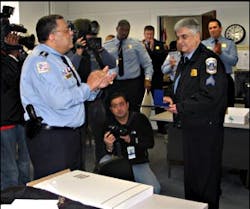
The primary source for media outlets to gain instant knowledge and access information about crimes is through public information officers (PIOs) and communication directors of law enforcement agencies. The dissemination of information to the media concerning victims and survivors who have been traumatized by crime is vital as a public service, as well a mechanism that can aid in potentially solving crimes.
"We have sensitive information that affects people's lives on a grand scale. What we say in public matters," says Ramon Korionoff, Communications Director for the Prince George's County Maryland State's Attorney's Office. When providing information to the media concerning criminal victimization, Korionoff says, "Victims always come first--the welfare and betterment of their situation is paramount to me. Victims have already been traumatized, and it is not our place as professionals in law enforcement to add to that burden."
Most PIOs agree it is standard not to disclose the names of victims or witnesses, and in some localities such revelations are prohibited by law. "The first and foremost thing for me is the protection of the rights and privacy of the victims and their families. If it comes to which side I err on, it's the victims, and our media knows that," says Mike Tellef, a PIO with the Peoria (Arizona) Police Department. Reporters need to understand, and sometimes be reminded, that their words, stories, and actions can lead to injury or death of certain parties if certain facts are revealed.
Lynn Hightower, Communications Director for the Boise (Idaho) Police Department says, "The last thing, as a PIO, I want to do is release information that further traumatizes a victim." A former TV news reporter for 17 years, she recognizes that victims provide the heart of the human drama that the media wants to follow. She admits that victims or their families may occasionally want to talk to the media and will request the PIO to facilitate the meeting. However, she also points out that the victim/witness coordinators in the department advise the families of media policies and explain to them they are not required to talk to the media unless they desire. Ms. Hightower acknowledges that some victims are traumatized, and they believe that talking to the media will enhance their trauma whereas others choose to talk to the media because they feel that by doing so they are raising public awareness.
An incident of random violence occurred in her jurisdiction in which a young man was severely beaten on a street corner; there were no suspects. The media tried to locate the victim and his family, but the family felt uncomfortable talking directly with the media. Consequently, the family spoke to the detective who, in turn, contacted Ms. Hightower, and she convened a news conference with the family. The result was a satisfactory outcome for all parties--the media was able to obtain the family's reaction, the media heard from the detective, and the family was able to make a public plea for assistance to find the perpetrator of the crime. The news conference was conducted in a controlled environment and in a manner that the family felt comfortable.
"Families want to put a human face on crime. The role of the surviving family tends to be one in which they feel like they want to do something to help," says Mary Grady, the Public Information Director for the Los Angeles Police Department. She continues, "When working to solve a case, always remember the people at home want to feel empowered."
Tellef also serves as a buffer between the victim, the family, and the media. "I always ask them. I have found many families want to talk. They find it very healing," he says. Like Hightower, he also set up a news conference with the media and the family of a case that involved a man who was pushed off his bicycle, hit, and stomped repeatedly on the head. The victim later died. Since the tragic event and subsequent news conference, the family has maintained periodic contact with Tellef.
Sgt. Joseph Gentile, a PIO with the District of Columbia Metropolitan Police Department for the past 35 years and on the force almost 40 years, has dealt with many cases involving victimization and a number of high profile cases including the disappearance and unsolved death of Chandra Levy, the Air Florida crash, the attempted assassination of former President Ronald Reagan, and the murder of two deaf students at the Gallaudet College for the deaf and hard-of-hearing in Washington, D.C. Highly respected by the D.C. media, Gentile explains that every case in the police department is treated equally. "We reassure people we will do everything we can to bring it to closure. The media decides what is high profile," he says.
Kevin Morison, Communications Director for the National Law Enforcement Memorial Fund and former Communications Director for the District of Columbia Metropolitan Police Department, acknowledges the importance of sensitivity issues regarding victims. "Law enforcement agencies are more sensitive to the needs of victims and survivors overall. The news media has to get information and get it out. Both sides need to be sensitive."
In the news business almost four decades, Gary Reals, a reporter for WUSA Channel 9 in Washington, D.C. says, "Every case is different. Every reporter tries to get a feel given the circumstances of the case. We are very sensitive to the victims."
It is essential that public information officers and the media establish relationships comprised of respect, trust, fairness and consistency to facilitate accurate and sensitive reporting on victim issues. Lorraine Whoberry, whose one daughter was murdered and whose other daughter survived an extremely violent and brutal attack combined with a sexual assault, poignantly summarizes the heart of the matter when she says, "The family has suffered the greatest tragedy of all, the murder of a loved one. For a moment, to the best of your ability, step into those parents shoes. Grasp the fleeting moment of fear, shock, and disbelief as you are being told your child is gone. Gone where? You ask. How would you feel being the parent and told this devastating news and all the person on the other side wants is a story"?