Mounted Units Significantly Impact Crime and Victimization
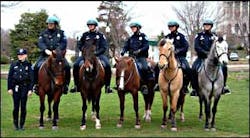
The effects of criminal victimization are often reviewed after crime has occurred, and therefore it becomes increasingly important to consider and develop crime prevention strategies as a viable mechanism for preventing crime and lowering levels of victimization. The use of horse mounted units in police agencies have repeatedly proven their usefulness by the favorable results they produce in the communities they serve.
In the past, some units have been disbanded and later reinstated. In their absence, the notable effects of their achievements became obvious. However, the U. S. Capitol Police Horse-Mounted Unit, in the nation's capitol, was one that was disbanded in September 2005--after only 14 months in existence--by congressional action led by the efforts of Congressman James Moran (D-VA). Unfortunately, the vitally needed unit has not been reinstated.
Former U. S. Capitol Police Chief and now U. S. Senate Sergeant-at-Arms, Terrance W. Gainer, who initiated the unit during his tenure as chief, astutely recognized the importance of the unit. "Mounted units are force multipliers for several reasons. They are great in crowd management situations, and they make an impression. Second, the public loves them which is great for the police image, the officers, and visible and interactive with the public. And, finally, they improve morale; officers like coming to work," says Gainer.
LAPD Horse Mounted Platoon
In California, the Los Angeles Police Department Horse Mounted Platoon (LAPDHMP) has city-wide jurisdiction. It is comprised of 32 horses and 32 officers (with authorization for 35), and the officers work in teams of two. The unit assists geographic divisions with handling crime problems. It is deployed to areas where resources are needed and where its tactics can be best used. It is not uncommon for the unit to assist with high risk warrant service and dignitary protection. The three primary missions of the unit include crime suppression, crowd control and management, and search and rescue.
The unit primarily concentrates on crime suppression. It has contributed to the Safer Citizens Initiative in which resources are deployed to clean up a general sense of lawlessness that prevails in the community. The horse-mounted officers work the Skid Row area and, since participating in this initiative, there has been more than a 30% reduction in crime overall, as well as a large portion of violent crime including robberies, assaults, and homicides. The platoon has flooded areas where homeless people have thrived in the narcotics business, and it has weeded out problems that fueled violent crime and victimization.
The platoon patrols Venice Beach, the second largest tourist attraction in Southern California, and an area where gang members are known to victimize tourists. From their vantage point of height atop a horse, the officers can observe densely crowded areas and can move in and amongst the crowd. "Because I have skilled police officers, they are looking intently for troublemakers who are walking away from us and who are flat out involved in criminal activity," says Lt. John Peters, who leads the platoon. Criminals also have no difficulty in spotting the mounted platoon to know they are being observed. "I can't stress enough that we are looking for voluntary compliance," Lt. Peters adds.
The platoon proved successful in a search and rescue mission. A 17-year-old male had called his father and indicated he was in the mountains and planned to commit suicide by taking a drug overdose. Lt. Peters and his platoon searched the mountains and located the young man, who had already overdosed and was not in good condition. They had him transported to a hospital via helicopter and, as a result of their efforts, saved his life. The platoon has also assisted in homicide investigations caused by arson.
Tampa Police
Disbanded in the mid to late 1980s and reinstated in 1995, the Tampa Florida Police Department Horse-Mounted Unit, led by Corporal Michael Morrow, has six officers and five horses. They engage in crowd control efforts centering upon college football and professional games. When patrolling parking lots, they ride in between cars and observe things that officers in a cruiser cannot. Car thieves, in the process of scouting out potential victims' cars, will leave when they see the horse-mounted officers. Cpl. Morrow explains that six kids were observed breaking into cars and chased down by his horse-mounted officers who apprehended three of them.
The unit also patrols the popular entertainment district of Ybor City that brings in as many as 50,000 people on a weekend night. As a result of the highly visible presence and patrol function of this unit, there is a positive impact on the quantity of victimization.
Chicago Police
Chicago's horse-mounted unit, comprised of 27 officers and 32 horses, has functions similar to the Tampa unit, and it serves as a key component in protecting the City of Chicago. The unit was previously disbanded in the 1940s and reinstated in 1974. It patrols the lakefront areas and parks in the summer and the business district in the winter. The mounted officers are also are used for crowd control at sporting events and during demonstrations.
Similarly, the Atlanta Police Department Horse-Mounted Unit, comprised of 14 horses and 12 officers, is deployed to high crime and tourist areas that draw millions of visitors yearly. It was disbanded in 2002 and reinstated in 2005. The unit is used as a strong method of patrol for effective crowd management and demonstrations. During the NCAA Final Four Basketball Championship, some of the opposing fans chose to continue their battle in the streets, which could have led to some serious incidents and victimization, but the mounted unit interceded quickly and diffused the potentially volatile situation. Major Calvin W. Moss, who is in charge of the unit, views it as a "victimization avoidance unit" and acknowledges that an officer on a horse is equivalent to 10 officers on foot.
Washington D.C.
In Washington, D. C., Sgt. Raymond Chairs, of the District of Columbia Metropolitan Police Department's Horse-Mounted Unit explains his unit is a standard patrol unit that is also deployed in high crime areas. "Crime drops to next to nothing when the horses are there. Statistically, violent crime drops drastically," he says. The presence of the mounted officers in the poor areas of the city has served as a tremendous tool for improving relationships between the community and the police. The unit was disbanded in 1926 and reinstated in 1973 under the leadership of former Chief and newly appointed Philadelphia Police Commissioner, Charles H. Ramsey. Like other units, it has effectively reduced the victimization that can occur during major protests, particularly when thoroughbred horses are present. "No one wants to argue with a 2200 pound horse," says Sgt. Chairs.
The Nashville Tennessee Police Horse Mounted Unit works a lot of big events, and the unit has handled over 600 events with as many as 2.2 million people. The unit is comprised of 12 horses and five full-time officers, along with five trained officers on call for special events. Sgt. J. D. Harber, who leads the unit, acknowledges his unit has made positive strides in reducing victimization. Our horse-mounted unit is a police resource. We use it every day," says Harber. He relates an incident that occurred at a Titan game in which a man used a forged $100.00 bill to buy a ticket from an individual. The victim approached horse-mounted Sgt. Harber, who immediately recognized the bill as a fake one. The victim provided a description of the offender to Sgt. Harber, who was able to find him in the crowd and arrest him.
Undoubtedly, horse mounted units are proven entities that serve a functional purpose with successful outcomes in the communities they serve. Their highly visible presence and the manner in which they are able to interact with members of the community, along with their advantage of height and mobility, make them an advantageous component of any law enforcement agency regarding their efforts to curtail criminal victimization.
About the Author

Karen L. Bune
Victim Specialist Contributor
Karen L. Bune is a Victim Specialist in the domestic violence unit of the State's Attorney's Office for Prince George's County, Md. She serves as an Adjunct Professor in the Dept. of Criminal Justice at George Mason University and Marymount University in Virginia where she teaches victimology. Ms. Bune is a nationally recognized consultant on victim issues. She is Board Certified in Traumatic Stress and Domestic Violence, and she is a Fellow of the Academy of Experts in Traumatic Stress. She appears in the 2007 edition of Marquis "Who's Who in the World."