Safely Handling Suspicious Person Stops
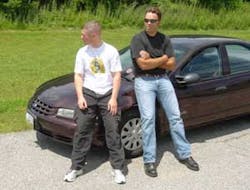
There the subjects stand: on a block in which you've had numerous calls and arrests for drugs, thefts, gang activity, you name it. Your job is to safely approach and interact with these subjects. If they are guilty of a crime your job is to find it out and make arrests. If it's nothing more than completing F.I. cards for documentation, at least you'll now know who they are and they'll know you're keeping an eye on them.
Checking out suspicious people on foot and in cars is a bread and butter part of police work. We do it everyday but sometimes our regular calls can become routine and routine kills. Law enforcement officers are killed and assaulted each year when investigating suspicious (around 11% for both categories in calendar year 2006 the last year for which full statistics are available). Do it wrong and you can become a statistic; do it right each and every time and you'll substantially reduce the risk.
One Officer Stops
I won't say that if you are alone you should never approach a suspicious person. For many officers this is simply the way business is done. You must understand, however, that it can be very dangerous to do so. So, prior to approaching if at all possible, surveil the subject and the area. Ask yourself if - based on the subject's apparent actions, size, sex, bystanders present and environment - this is something that you can safely do? If not, wait for backup or do not initiate the stop. Realistically your attention will be focused on the subject and may open you up to attack by unseen suspects. If the suspect resists lawful detention or arrest you're on your own until backup arrives. If reasonable articulable suspicion exists to detain a person you may handcuff the person for officer safety. This cannot be an always thing. You must be able to articulate why your safety was at risk i.e. activity, time of day, location, subject actions etc. and like all use of force it must be objectively reasonable in light of the totality of the circumstances. If probable cause exists to make an arrest, handcuff first then search.
Subterfuge
When I worked street narcotics while in uniform my partners and I would frequently have to approach and identify suspects that our undercover officers or informants had just made narcotics purchases from, for later arrest as the case progressed. Oftentimes we used a feint such as canvassing the area looking for a lost little girl. After describing the little girl and asking if they had seen her, we would then ask for I.D. so that we could, "document who we talked to." A little bit of BSing can go a long way to allay suspect's fears giving us an edge. When you're interested in narcotic activity do you really want to ask, "You guys aren't out here slingin' dope are you?" Sometimes we cannot hide our intentions but other times a little subterfuge works well.
Read Body Language
Read the suspect's body language looking for early warning signs of a potential attack such as failure to follow commands or ignoring your presence; exaggerated movement; physical crowding; or looking around for an escape route, your back-up or his back-up. Suspects assume pre-attack postures subconsciously. Pre-attack postures include: assuming some type of boxer stance; raising the hands above the waist; shifting the shoulders; and grooming gestures.
As suspects subconsciously react to the effects of fight or flight, they may pump their hands, blood may drain from their face or their head may tilt back. Failure to read body language and a suspect's preparation to flee or attack may result in you being assaulted before you can respond.
Distance Equals Time
The Reactionary Gap is a concept based on the rule that distance equals time. The gap or distance you stay away from a suspect provides time for you to respond. At touching distance a suspect can assault you before you can react and respond. Based on this response time deficit it is recommended that you maintain at least six feet from the suspect. As you close the gap to an offender to frisk or handcuff you must do so anticipating resistance and with your hands up ready to respond.
Contact / Cover
Developed by the San Diego Police Department after two of their officers were shot and killed while checking out suspicious suspects in a park, contact / cover is a lifesaver. One officer is designated as contact and takes care of the business of the call (interviews, frisks, handcuffs, talks on the radio, etc.). The cover officer positions himself to protect the contact officer from the suspect and third parties and is prepared to use force if necessary. My agency has used this concept for a number of years and it is a very strong tool while checking out persons and vehicles.
Look at the Whole Picture
Suspects will frequently hide contraband such as drugs or weapons off their bodies but close to them. Rock Crack Cocaine can be hidden in a discarded potato chip bag that looks like trash nearby. A pistol can be hidden behind a wall next to the suspect. Suspects will pay attention to the way you do things and if your searching is sloppy or neglects areas nearby or on their person such as the groin or anal cleft, you can bet that's where they'll be hiding their weapons or dope.
I can remember when another officer prior to a tour of duty was searching under his rear patrol vehicle seat and found a butcher knife and an eight ball of Crack. Although this necessitated that he tag it into evidence (making more work for him) the officers that used the car in a prior shift could have been stabbed when they placed their armed suspect in the seat behind them. How many times have deputies at the local jail found contraband or weapons your street officers missed?
Watch their hands. Look for bulges in a suspect's waistband or the clips of knives in pockets. Don't just casually look but rather look for weapons or items that could be used for weapons against you.
Conduct these actions as if your life depended on them. Why? Because it does.
Do It Right Every Time
Have a plan of action. Talk to your partner or shift mates about standard operating procedures and tactics for handling suspicious person stops. Use sound methods and tactics such as Contact / Cover to dominate suspects and reduce the likelihood of attack against you. Always approach a suspect(s) with your head in the game and mindful that life is a live-fire 360 degree environment. The mental edge coupled with sound tactics can and will foil assaults against you as you check out people that are engaging in criminal or suspicious activity.
From the time your feet hit the street to make your initial approach to the point you're driving away - be mentally prepared and ready to handle any resistance or action that may come your way!