Man Hunters
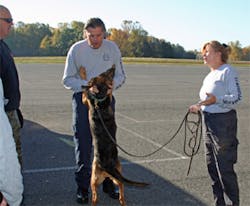
Chasing bad guys... I loved the thrill of the hunt, but I wasn't always successful in catching them, especially if the trail was cold. There's only so much that a cop can do when following a trail; when all else fails we need to call in the experts that excel in hunting - the Bloodhounds.
This particular breed of dog is over a thousand years old and it thrives on the hunt, and thereafter the reward from its handler. Hounds could care less about a kill. Their very existence is all about tracking, whether it is a kidnapped child or a felon on the run, this breed is born to follow a scent. They are built for the long haul, able to follow a trail for hours and hours. Unlike their law enforcement brother K-9, the patrol dog, these guys need to be kept on a lead lest they bound off to who knows where while following their nose. Ironically, it's not a good idea to obedience train this breed, as it interferes with their natural instinct to track. But the bottom line is that these dogs love to work, and they do it out of a sense of love and loyalty for their handler.
I was privileged recently to witness some hound training conducted by Kevin and Robin Kocher. In 1999 they founded The National Bloodhound Training Institute (NBTI). It's a non-profit organization whose goal is to promote the use of "man trailing" Bloodhounds by providing quality instruction to LE agencies and volunteer search and rescue personnel. Kevin explained that a handler must be able to recognize his dog's movements of purpose. He refers to these as "Negative Indications." In the early 1990s, Kevin surmised that this method increased a handler's success rate when attempting to locate a victim or a suspect. This technique essentially whittles down the area, telling the handler where not to look.
One of the things that Robin and Kevin emphasize is what they refer to as "Intensity Training." They feel that intensity is the most important element to focus on throughout the dog's training. Rather than just take a hound out on a long trail for the sake of training, instead focus on each component, i.e., the start, the trail and the end. I observed Kevin conduct a couple of training sessions with two of his own dogs. He was adamant about the importance of the dog/handler relationship. For instance, getting the dog out of the vehicle to work should be done in such a manner as to get the animal excited about what is to come. Just as importantly, at the conclusion of the exercise or trail operation, the dog needs to be rewarded and his behavior reinforced with plenty of praise and a treat.
Working a dog like this requires certain rituals. Kevin demonstrated one of these. Referred to as the "pre-scent method," this technique is used to allow the dog to get ready to follow the right direction. He uses a harness to give the animal a cue that it's time to get to work. It's not so much the harness itself, but rather the motions that the handler goes through while putting the harness on the dog. Before this occurs, the animal has been allowed to smell the scent article. Now, while the harness is being fastened on the dog, the animal has time to figure out which direction of travel to take. In fact, while Kevin demonstrated this technique I could see the dog's head already facing the direction that he had decided was the right trail.
Not unlike what ritual a sniper goes through each time he prepares himself to take a shot, rituals with working dogs carry the same importance. Doing things identically each time the animal is about to go to work, ensures that it knows it's time for business. The dog makes no distinction between training and the real deal. That's why it's so important to do things the same way each time. (Sound familiar: "the way you train is the way you fight?")
I watched as Robin conducted an exercise with one of the dogs. The object was for the dog to locate a suspect that had fled on foot. The dog is first given a scent article and then begins to follow that scent. In short order, the dog followed the trail to a public restroom and tagged the door where the suspect was hiding. It was remarkable in that the trail was over concrete and grass, neither surface being any hindrance to the animal's ability to follow the scent.
This innate ability is truly extraordinary. Kevin briefly related an incident in which he and his dog were involved that resulted in the wanted suspect being located and arrested. A woman had been abducted in Bucks County, PA; her body was later found in Maryland. However no evidence had been obtained by local authorities until the trail dog was brought into the case. The dog subsequently followed a trail to a building in an industrial park where it identified a particular building. Police were able to show a photo spread to individuals inside that warehouse. An arrest was made as a result of the dog tagging that building; the individual was arrested and convicted of kidnapping and murder.
Robin pointed out something very interesting to me concerning scent articles. She told me that it was important that only the handler pick out and touch the appropriate article to be used. That way there is less scent contamination on the piece and less chance that the dog will be confused. In the past I had never given that any thought, but having seen the dogs at work it now makes a lot of sense.
Kevin and Robin Kocher are two truly remarkable people. Their love of Bloodhounds is obvious, but they have both gone above and beyond in their dedication to training other LE and rescue personnel. They conduct seminars and training all on their own time and dime, and if you visit their website you will find a number of free downloadable books and pamphlets with information on trailing and tracking dogs. If you are a handler, or your agency is looking for training, NBTI is the answer.
Stay safe brothers and sisters!