Lab on Loan
While some areas of the country may not remember June 2008, Cedar Rapids, Iowa, does. Along with much of the Midwest, the city experienced significant flooding. The city's previous flood record, set in 1993, was about 20 feet. When predictions were made about the flood last June, the police department paid close attention not only because they knew they would have to be prepared to respond to calls for help, but because the 10-year-old police headquarters was built along the river.
"We're built up in the 500-year flood plain so we didn't think the flooding would be a big issue for us," says Cedar Rapids Sgt. Joseph Clark. But just in case it was, a temporary dirt dike was built behind the police station to provide protection up to 26 feet.
That wasn't enough. On June 13 the water crested over 31 feet and covered about 10 square miles. Since the Cedar River runs through the center of town, the downtown flooded. No lives were lost but nearly 5,000 residential properties (about 25 percent of the residential homes), about 2,000 businesses and 750 nonprofit organizations were affected. Power was lost, and the police department's emergency generator was flooded, causing the police department to lose power and evacuate the building.
Most of the damage at police headquarters occurred in the basement, which housed the crime laboratory and evidence storage area, the locker rooms, a workout facility and a mechanical room.
"We didn't expect to get flooded," says Clark. "They built a temporary levee. They were predicting a 24-, 25-foot crest. We thought we would be good."
Thinking they were being overly cautious, they moved the Automated Fingerprint Identification System (AFIS) to the second floor. Items on the bottom two shelves in the evidence section were moved to the upper shelves, and anything on the floor was moved in case the sewer backed up or water came in.
But water filled the basement 8 feet high, just 2 feet below the ceiling.
"We lost everything in our ID lab except the AFIS," he says. "All of our evidence, more than 250,000 pieces, was flooded with water mixed with sewage, diesel fuel and everything you can imagine."
A foot of mud and muck was left after the water receded in the basement.
Working to clean the evidence storage area, the police department obtained a court order to destroy everything more than 3 years old that did not involve a felony. Anything salvageable for homicide or active felony cases was packed into one of two freezer trucks to stop mold and microbiological growth and structural deterioration. Maintaining the chain of custody was part of the entire process as the semi trucks transported the items to a regional Munters Corp. document recovery center, where they were inventoried, dried and restored (see sidebar on opposite page).
When the police headquarters at 505 First St. SW was evacuated, it was relocated outside the flood zone to the city's ice arena for about three days, and then to an old office building about 5 miles from downtown for two or three weeks.
Finding a crime lab ASAP
Figuring out what to use for a crime laboratory was more than a predicament.
"In the middle of the flood, we had a homicide," Clark explains, adding that fortunately there wasn't a lot of evidence to process because the homicide occurred outdoors. While plans were made to rebuild the lab on First Street, the police department had to do something.
About 25 percent of the city was flooded, the rest of the city was not and business — including crime — went on as usual.
"We couldn't go without a lab," he says.
Police Chief Greg Graham instructed Clark to find one regardless of what it cost. However, Clark says he was told a mobile forensics laboratory could take months to build.
He remembers saying, "That's not going to work."
A call to the International Association for Identification led him to the National Forensic Science Technology Center (NFSTC), which has six deployable forensic laboratories for agencies to borrow. NFSTC's Chris Vivian says the labs address a variety of needs such as:
- A deployable laboratory can be beneficial when crime scene personnel need to spend a lot of time working at a crime scene in a remote area.
- A terrorist act requires forensic analysts to work 24/7.
- A natural disaster destroys or nearly destroys an agency's crime laboratory.
- A lab is behind with its work and additional lab space would help reduce a backlog.
- An agency hires a large number of new staff and needs space to conduct hands-on training.
The laboratories were developed with the Department of Defense and the Defense Threat Reduction Agency, and delivered to NFSTC in fall 2007. They are loaned to agencies for free under a National Institute of Justice grant.
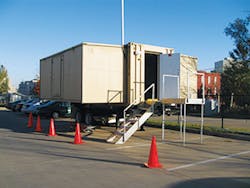
When Clark heard the word "free," he was ecstatic. He didn't think the chief would believe they could get an 8-foot by 20-foot by 8.5-foot lab module for free. With the sides pulled out, the lab provides 400 square feet of dust-proof and light-proof workspace. It has an access-controlled entryway, data-sharing capabilities and a generator.
Equipping the lab
The inside of the lab is empty — ready to house any forensic discipline or in a situation like Cedar Rapids' — three or four people tasked with more than one discipline.
Clark visited NFSTC in Largo, Fla., and looked at a display module to get ideas for equipment to buy for use in both the temporary laboratory and later in the restored permanent crime laboratory. Having experienced a flood, Clark looks at technology differently. For example, he considers ductless fume hoods a necessity.
"If another flood comes, we just unplug them, cart them out onto a trailer and set up shop at the next place," he says. "We need to do what we can internally to avoid a complete shutdown if we flood again."
Looking ahead
Cedar Rapids started using the deployable lab in October 2008. Clark, who was promoted from the Crime Scene Unit to Planning and Development in March, is hoping reconstruction on the permanent laboratory can begin in the fall. Cedar Rapids signed an agreement saying they needed to borrow the module from NFSTC for 1 year, but realistically Clark says it might be longer.
Months after the flood, the police department is still realizing its losses. When the citizens' police academy asked the ID Bureau to do a presentation, personnel discovered their teaching aids and fingerprint card collection were gone.
"You're always looking for something you had," he says. "You forget about the little things that were always there that you didn't ever think about. It's traumatic to lose all that — yet there's still the pressure of doing a good forensic investigation. Defense attorneys are not going to give you any breaks because you were flooded. They're going to use that to their advantage."
Finding a place that is both secure and safe to process evidence wasn't easy for Cedar Rapids.
"What follows a disaster is made worse by not knowing where to turn for help," he says.
Clark hopes other agencies learn about the deployable forensic laboratory so that if something happens to their lab, they have a plan B.
"We didn't know that something like this was available," he says. "We're glad it was. The lab has really been a lifesaver."
Rebecca Kanable is a freelance writer specializing in law enforcement topics. She can be reached at [email protected].
Saving wet evidence after a disaster
Most often law enforcement agencies call Munters, a large property damage restoration company, for help when there's been a fire or natural disaster (a flood, a hurricane or tornado, for example).
"Our goal is to get them items they can continue to use as possible evidence," says James Gilbert, national account manager for Munters document restoration services. "We control the damage to prevent it from getting worse."
Which restoration process is used is based on what the item is or if it has already gone through DNA testing. There are two ways Munters dries items: In a low vapor pressure desiccant chamber or vacuum freeze dryer. Which process is most appropriate depends on the condition of the materials and what lab testing needs to be completed. Munters restoration specialists together with their clients decide what methods will allow Munters to return the materials in the most useful condition for use as evidence.
"When you get involved in evidence, you have to look at every piece and every case and decide which process makes more sense," Gilbert says. "Having an understanding of the item as it relates to the case is what's most important. If you have a sneaker, it's important to know if it was collected for DNA or a shoe print, for example. And that understanding needs to come from the police department and the district attorney's office and be shared with the restoration company."
Gilbert has seen more restoration successes when a disaster plan is in place, he says. "What are you going to do if your evidence is damaged by a flood or fire?" he asks. "The worst thing you can do is not have a plan."
To agencies preparing for natural disasters, Gilbert offers these thoughts:
- Time is of the essence. Don't wait to decide what you're going to do with the wet items. At least get them stabilized so the damage doesn't get worse.
- Know exactly what you have. Have a good inventory that indicates what types of analysis the items have gone through.
- Chain of custody protocols should be in place.
In court, the state was able to exhibit clothing as evidence after it was vacuum freeze-dried and restored by Munters, and the defendant was ultimately convicted of attempted murder and assault.
No item that goes through a major flood is going to go back to the condition it was in before the flood, Gilbert says, but further damage can be prevented and make a big difference to a case.
If you need to borrow a lab…
The six deployable forensic laboratories from the National Forensic Science Technology Center are available free of charge through a National Institute of Justice grant and can be deployed to address a variety of needs.
If one 400-square-foot lab module doesn't provide enough room, modules can be set up side-by-side with a walkway between units.
For more information, contact NFSTC Chief Executive Officer Kevin Lothridge at 727-549-6067.