The Perfect Survival Blade
Editor's Note: While many in law enforcement don't understand the need for any officer to have such a knife, we must remember that "law enforcement" encompasses a wide variety of positions to include those working wilderness areas. This article was written mostly for them. Those not included in the "mostly" might be officers who enjoy outdoor life in their off-duty time. -Ed.
---
Yes, I am being exceedingly arrogant. I have spent the past six years now writing equipment reviews and a large number of them have been about knives. Fixed blade knives, folding knives, "survival" knives, combat knives... all kinds of knives. For all that I have yet to find what, in my egotistical mind, is the perfect survival knife; that is, the knife I'd consider optimal if it was the ONLY knife I could have. So, in this review, I thought I'd share my thoughts about the "perfect survival knife" and then tease you with this bit of info: one knife designer may already be working on it.
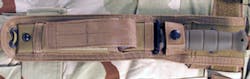
Before I delve too deeply into the characteristics of the knife let me get the information about the sheath out of the way. Because of some of the design features of the knife I think the sheath needs to be nylon with a hard insert. Leather would certainly work but isn't as easy to combine with a utility pouch on the front, MOLLE mounting on the back and can be damaged by exposure to water and/or chemicals. A synthetic or nylon sheath with a synthetic insert is what I think would work best for this particular knife. A utility pouch can be included on the front, or just a method for mounting one. On the back the sheath should have an incorporated system for MOLLE mounting as well as belt wear. Shown above right is a sheath made by BLACKHAWK! that would probably work if we limit the blade length.
Since that brought us to blade length, let's talk about that for a minute. A good survival knife can have a blade as small as five inches or as long as ten depending on how you plan to use it or what capabilities the designer was going for. My preference is for a blade that is minimum six inches but maximum of 7.5". Combined with a 5" to 5.5" handle that makes the overall length anywehre from 11" to 13" - which is a big knife. The blade needs to have enough weight in front of the balance point that it can be effectively used for chopping chores.
On the spine of the blade I'd like to see at least 5" of saw teeth - more if it will fit. Now, please don't misunderstand. I'm not talking about the "saw teeth" you see on so many knives which are really just cut-outs in the spine. I'm talking about a true kerf cut saw section.
SOG Knives' Team Leader II has a saw edge on its spine. Pictured to the left here you can see exactly what I'm talking about. The SOG TLII only has a 5" blade and the large majority of the spine is saw teeth. If a knife was designed with a 7" blade (as an example) I see no reason why the spine couldn't have 5.5" to 6" of saw teeth. The limit on the length would be a function of how much space actually existed between the hilt (because I have plans for that as detailed below) and the one inch false edge on the back of the drop point. A 7.5" blade would offer than other 1/2" of saw teeth. It can be done. If there is any way to add another feature to the spine, I'd love to see a gut hook placed between the 1" false edge on the back of the drop point, but before the beginning of the saw teeth on the spine.
Now, just because I put saw teeth on the spine that doesn't mean I don't want any serrated sections on the main edge. Near the choil I'd like to see 1.5" to 2" of serrations. That makes cutting rope a tad easier but doesn't take up a lot of the plain edge that cuts meat and other organic substances so well. There are a variety of serration designs and specifications on the market today - put forth by various manufacturers each proclaiming that their way is the best most effective. I'm not picky about which serration design gets used as long as it cuts well. Performance needs to be the main focus of this knife start to finish.
Now we come to the one conundrum I have about a particular design feature: the hilt. You see, I kind of like the full hilt design such as can be found on the Gerber Silver Trident or the Buck Knives Buckmaster. (The Gerber Silver Trident is shown above right for reference) On the other hand, I like having lashing holes in the hilt "points" so that the knife can be easily tied to a pole for use as a spear if necessary. I would like to find a happy compromise that offers as close as possible to a full hilt, but of material that is only as thick as the blade (which would have to be full tang by the way) and with properly placed lashing holes at the base of the hilt spreads.
Given that the grips shouldn't have to be removed to lash the knife to a pole, such utility wouldn't be harmed by having the butt end of the tang be wider than it is in the rest of the knife. Yes, I know that creates a manufacturing headache and I'm sure some design engineer can come up with a cool, cost effective solution. I just want to be able to hammer with the butt of the knife. I also like the idea of having some type of accessible storage space in the handle. However, having removable grip slabs could present other engineering challenges. There wouldn't need to be a great deal of storage space. The amount I'm thinking about would be just sufficient to hold a couple small fish hooks, some line, a few matches, etc. Nothing major. The inside of the grip slabs could both be hollowed out with a space cut into the tang. By removing only ONE grip slab the space would be accessed.
Of course, the handle should be comfortable in the hand which means some curve and finger grooves (or at least one for the index finger so that a secure grip can be found and confidently gotten by touch). There should be a lanyard hole near the butt of the knife - as should be found on every fixed blade made for serious field work.
So, there's my vision of the perfect survival blade. I'd enjoy reading your thoughts and comments about what you'd change or how yours would be different.
Stay Safe!
About the Author

Lt. Frank Borelli (ret), Editorial Director
Editorial Director
Lt. Frank Borelli is the Editorial Director for the Officer Media Group. Frank brings 25+ years of writing and editing experience in addition to 40 years of law enforcement operations, administration and training experience to the team.
Frank has had numerous books published which are available on Amazon.com and other major retail outlets.
If you have any comments or questions, you can contact him via email at [email protected].