In 2008, major flooding wreaked havoc in the Midwest.
"Since 1993, we haven't had that kind of flooding," recalls Missouri State Water Patrol (MSWP) Sgt. Gerald Jerry Callahan. On March 16 flash flooding began through the smaller streams and lasted through April. In June, the Mississippi and Missouri came out of their banks. "By the end of July, we had 9 inches of rain," recalls Callahan. "Mark Twain Lake was at its highest level. We got a lot of calls for rescue and evacuations."
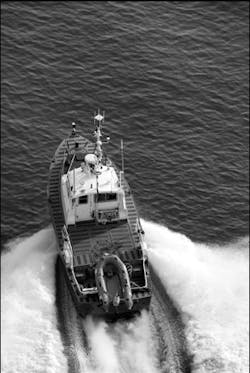
During this time officers trained and equipped in marine patrol came into view. Agencies like the MSWP prove they are invaluable not only during natural disasters, but also on a daily basis, as they strive to keep water areas safe. Other agencies like the United States Coast Guard and the Oregon State Marine Board (OSMB) assist in this mission as well.
Missouri State Water Patrol
Created in 1959 as the Missouri State Boat Commission, MSWP officers had no law enforcement status. The nine original officers were neither certified nor armed. Celebrating their Golden Anniversary in 2009, MSWP now boasts 97 law enforcement-certified, uniformed officers. Although the officers have statewide jurisdiction, they predominately stay within their "original jurisdiction," the water. MSWP patrols over 272,770 acres of lakes, 5,500 miles of shorelines, 519 miles of the Mississippi River and 533 miles of the Missouri River. It also patrols major reservoirs and countless smaller tributaries and float streams.
MSWP officers handle additional duties; a dive team performs underwater recovery of drown victims and searches for evidence. Callahan calls them the "official homeland security team for the state of Missouri." Local counties use the unit for criminal evidence dives. MSWP also has a K-9 unit and an accident reconstruction team. "Our department is divided into six sections throughout the state," Callahan explains. "Each district has someone who is a criminal investigator who has gone through extra training."
Becoming water patrol
MSWP officers attend a paid, six-month-long stint at the academy, where they attend basic law enforcement classes including defensive tactics, constitutional law, emergency operations and vessel stops and searches. In addition, officers need 60 hours of post training a year. MSWP selects candidates who can deal well with the public and work well independently. "Our officers work on their own quite a bit and are more isolated because of where they work," says Callahan. "In a lot of areas you are the only one out there."
In part due to exemplary candidates and training, in the last three years two MSWP officers received awards from the National Association of State Boating Law Administrators (NASBLA). In 2006, Water Patrol Corporal Elizabeth Ratliff became NASBLA's sole Officer of the Year recipient and the first in her agency to be honored with the title. She is also the first female to be given the award. Following her, Water Patrol Officer Frederick Guthrie Jr. received the NASBLA 2008 State Boating Officer of the Year award.
Along with keeping waterways safe through patrol, MSWP officers conduct education and advocacy. "Every officer does boating safety classes," says Callahan. "We offer them at the schools and community centers. Our officers spend a lot of time teaching classes in the off season and we're trying to offer them in the summer. We come to safety fairs and go to schools to do one-hour presentations."
Boats for all waterways
"Our officers are some of the most expensive state employees," says Callahan. Each officer has at least one boat, sometimes more. Each officer also has a truck to pull the boats with. "For certain bodies of water, we've been forced to increase the size of our patrol vessels due to safety," says Callahan. "There was a time when our boats were too small on some lakes to get the job done."
The agency uses different boats depending on the waterway. Bass boats are utilized on some of the smaller lakes and rivers. Inboard and outboard jet units meanwhile run small, shallow water.
Officers also have access to side-skin sonar equipment. "Before it would be a long process doing search grids," Callahan states. "Now with sonar mapping out the bottom of the water, you can try and identify ... what you are looking for. Over the years, we've started equipping our regular patrol boats with a scaled down version, so there is something immediate."
Keeping up with technology
MSWP receives funding through the state and federal government. General revenue money goes into the water patrol through the state legislature every year. In addition, the marine patrol receives some federal money through grants, as well as a percentage of money dedicated through boating registration. Close to half of MSWP's funding comes from general revenue. The remainder is dedicated funding and federal funds. "In the time I've been on, our budget has almost doubled," Callahan explains. "That has to do with the equipment. We have to keep up with technology and it gets more specialized and more expensive as it goes along."
"[The MSWP] is proud of its history," Callahan explains. "Proud of the fact the citizens of the state of Missouri have chosen to keep the agency funded and marine intensive. We have proven our officers are an asset to the community and other agencies."
U.S. Coast Guard
Another agency with a water safety mission is the Coast Guard. Officers in the law enforcement division assist in this goal. "We are multi-mission," says Coast Guard Chief Lou Orsini. "We can do search and rescue, respond to an oil spill and get involved in international events. We have authority to board, inspect, search, seize and examine any vessel anywhere."
In the aftermath of Hurricane Katrina, the Coast Guard operated boats throughout the region. "We brought them into the flooded regions and assisted people in getting out of their homes," Orsini explains. "We helped with helicopters and small boats."
All boarding officers are qualified by their commands and must complete a certain number of training hours. The Coast Guard offers a five-week course in Charleston, N.C. After that, officers continue training with their units. "An individual doesn't have to go through that five-week course," Orsini says. "Instead they can learn on the job under their commanding officer, or they can do it individually on their own time, learning what they need to learn. They have to pass the board and have the complete trust of the commanding officer."
The Coast Guard partnered with many different agencies, including NASBLA, in creating the National Recreational Boating Safety (RBS) Strategic Plan. In addition, the Coast Guard offers grant opportunities. Since 2004, hundreds of officers have been trained through these grants in Boating Under the Influence (BUI) techniques and technologies. Along with national administrative partnerships, the Coast Guard does joint operations with the Royal Canadian Mounted Police on the Great Lakes, exemplifying the Strategic Plan's motto: "The Power of Partnerships."
USCG equipment and funding
"When we are operating from small boat stations, they are operating from 18-foot to 54-foot boats," explains Orsini. "For law enforcement boardings, we typically use a 34-foot vessel, which is built for law enforcement needs. At sea, we operate from the larger cutters." These are rigid hull-inflatable boats. Approximately one-seventh of the Coast Guard budget goes toward law enforcement funding.
Orsini states they are a military and multi-mission organization that exists to serve the public through a variety of safety and security mechanisms. He adds they also have a large number of inter-agency and national partners.
"We have 35,000 really dedicated folks in uniform and 8,000 in civilian clothes doing a great job to save others and stop bad things from happening to the U.S.," says Orsini. "We're very proud of our folks."
Oregon State Marine Board
Unlike the MSWP and Coast Guard, many marine patrols exist as only a single part of their agency. Many departments dedicate smaller divisions to their water jurisdiction. Recognizing the necessity for a one-stop organization to assist, the OSMB filled that need in Oregon. "In the law enforcement program, over the years we have evolved to where we are doing everything we can to assist local marine programs," says OSMB Law Enforcement Program Administrator William Rydblom. OSMB funds local agencies' equipment and training. "Everything related to law enforcement and education," he states. "We have a hand on their back and on their shoulder helping them out."
OSMB training
Along with funding, OSMB offers a two-week marine law enforcement training. "In that period, we take deputies and troopers and give them the same boating information they would receive if they were to go to a Coast Guard Power Squadron course," explains Rydblom. "They learn how to enforce laws. They do boarding scenarios and accident reconstruction. We spend a day pool side practicing officer safety. It gives them a general flavor of what they are going to be dealing with."
Due to many marine units being seasonal, OSMB offers a pre-season training conference designed to "catch their attention, give a refresher, talk about patrol strategies and [talk about] scheduling … things they need to do to have a successful season," says Rydblom. OSMB also holds a post-season conference, debrief and awards banquet.
OSMB equipment
Oregon's amount of marine areas, including large rivers like the Columbia, coastline and in-land waterways create diversity for local law enforcement. "They have a lot of variety," says Rydblom, "so they need a variety of boats and enough officers to patrol from coast to bay." Local agencies use a dozen makes and manufacturers. "The main-stay is something around a 20-foot inboard, aluminum jet-sled," he says. "We have boats as big as 32 feet. Most boats are aluminum-hulled but 10 percent are fiberglass." With current economic difficulties, fuel efficiency plays a larger part. "We don't want to cut back on patrol and we find that when the fuel gets up too high there is more vehicle patrol done. Deputies take a vehicle and stop and walk the docks to save fuel. We are looking at more fuel efficient motors for propulsion-cleaner, quieter and more efficient."
OSMB also issues permits for marine events like fishing derbies and boat races, though a county sheriff needs to sign off on the event. During the Portland Rose Festival, as many as 10 different agencies patrol, many of which were trained and funded by the OSMB.
Service and safety
Whether an agency is solely a marine patrol, like the MSWP and Coast Guard, or an organization dedicated to serving law enforcement marine units, there are unique aspects to working on the water. In daily operations, officers need appropriate training and equipment. Funding is an issue and a priority. Under normal circumstances, marine units keep waterways safe and educate the public about RBS. During natural disasters, marine patrol officers prove invaluable to preserving life.
"Our emblem says service, protection and safety," says Callahan. "We are here to serve the citizens of our state. When we're needed, we're ready to go. We'll always respond when called upon."
Michelle Perin worked as a police telecommunications operator with the Phoenix Police Department for eight years. To contact Perin, visit www.thewritinghand.net.
About the Author

Michelle Perin
Michelle Perin has been a freelance writer since 2000. In December 2010, she earned her Master’s degree in Criminology and Criminal Justice from Indiana State University.