The 9mm Option
Developed in 1902 by Georg Luger, the 9x19mm Parabellum cartridge can brag about being over 100 years old and more successful now than at any other time. Tested by the U.S. Army at the Springfield Arsenal in 1903, the round was actually adopted by the German Navy in 1904 and by the German Army in 1906. The U.S. Army - in 1911 - adopted the .45ACP. Given the plethora of 9mm weapons available, how widely the round is used, and how often I've carried a handgun in this caliber across the span of the last two and a half decades, I thought it would be enjoyable to look back at the weapons and which options I still have available today. Bear in mind I'm not going to list every 9mm handgun made - only the ones I can put my hands on within ten feet of me as I type - or used to own.
And before I get too far into this, let me assure you I'm not going to debate the .45ACP vs 9mm (or .40S&W for that matter). Here's why: if you're using modern hollow point bullet designs I'm just not sure there's a significant enough difference in terminal ballistics to argue about. I believe that shot placement matters more than hole size. Moving on...
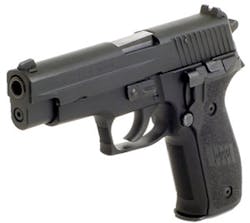
Sig Sauer P226 I'm going to start out with the Sig Sauer P226 only because it's the first 9mm that I ever carried on a daily basis. In 1987 the police agency I was working for decided that the issued 6" Colt Trooper .357 Magnum revolvers were a bit outdated. It didn't help that not a single officer was carrying the issued revolver; each of us had gone out and purchased a 4" .38 or .357. So the agency decided to switch to the 9mm and went through an evaluation process to select one. The winner was the Sig Sauer P226.
The basics about the Sig:
Caliber: 9mm
Trigger Pull: 10 pound double action, 4.5 pound single action
Length: 7.7" (per Sig's website)
Height: 5.5"
Width: 1.5"
Barrel length: 4.4"
Sight Radius: 6.3"
When I went to the armorer school for Sig in 1988 (they were still in Virginia back then) I learned to like the P226 design even more. Sure, there was a couple of roll pins to deal with, but the gun - by and large - was fairly simple and highly reliable. During our selection process all officers who shot the Sig found it more comfortable than the other pistol options and most had no trouble qualifying with it as well as, if not better than, they did with their revolvers.
When I left the agency I had to give up my Sig and I haven't had a P226 in my armory since then - but that will be rectified shortly (I'm waiting for the paperwork to clear the state's folks now).
Heckler & Koch P7 While I was working for that agency and carrying the Sig P226 on duty, my off-duty gun - for awhile - was an H&K P7. The photo above right shows a P7M13 but mine was what eventually became the P7M8. Mine was so old that it still had the European style magazine release at the heel of the grip. The P7 is essentially a recoil-operated firearm with several unique features. The most obvious is the lever located on the front of the grip that pivots at the bottom. This lever performs a multitude of functions that most pistol aficionados expect other controls for. Double action trigger? Not to be found here. Squeezing the lever cocks the weapon. Single action trigger? Once the weapon is squeeze-cocked, that's what you have, but if you haven't loaded the action by squeezing the lever in, the trigger is a dead piece of pivoting metal that accomplishes nothing. Decocking lever? Not to be found. If the weapon is cocked it's because you've squeezed in the lever to load the action. To decock the weapon, simply loosen your grip to release the lever.One of the most interesting features of the weapon, but one that isn't noticeable until you field-strip it, is the gas-retarded operation. My pistol came with tritium three-dot night sights and I was surprised to measure a six-inch sight radios (distance between sights) on the pistol. As compact as it appears, I was expecting the sight radius to be reduced. Not so. As a comparison, The Beretta M9 (92FS) and Glock mid-sized 9mm/.40 caliber pistols have approximately the same sight radius, the difference being 1/8 of an inch or less.
Shooting the P7 is a dream. Due to the gas cylinder that is incorporated into the design, the straight recoil and the 9mm caliber, the felt recoil is very light. This lessens the time required to get back on target and the fixed barrel increases the inherent accuracy of the weapon. Two examples are shown of test groups fired free-hand from seven yards - just over twenty feet. The groups we fired averaged two inches with the smallest coming in just under an inch and a half (1.5"). I miss my P7 and regret ever having sold it (especially given what they sell for now) but I don't see adding another one to my armory any time in the foreseeable future.
Beretta 92F / M9 At my next police agency the issued duty weapon was the Beretta 92FS. I can't say that - at the time - I was a huge fan of the Beretta 92F but it grew on me. The Beretta M9/92FS is a short recoil, semi-automatic pistol chambered for 9mm NATO ammunition. That's a 9x19 case with a 124g full-metal-jacket bullet. My agency issued Federal HydraShok 124g +P+ ammo and it functioned well. Internal, external and terminal ballistics had proven sufficient for our duty use. The barrel length of the Beretta M9 is just under five inches (125mm = 4.92": designed in Italy = metric measurements). The M9 has an ammunition capacity of 15 rounds in each magazine. If you add a chambered round, you have a total of 16. Extended 21 round magazines are available but became harder to find when the now-defunct infamous Clinton gun laws went into effect.With an aluminum-alloy frame, and a steel slide, an empty Beretta M9 weighs about 2.1 pounds. Add in the fifteen round loaded magazine and you get a total weight of about 2.6 pounds. The trigger pull in single-action is 5.5 pounds, with the double-action pull straining the scale at 12.3 pounds. Since reloads are inevitable, the magazine release can be put into the frame to suit either a right- or left-handed shooter.
I spent eight years with this gun riding around in my duty holster - and out of it on more than a few occasions. I'd be quite comfortable with it in my hand today but I in my armory I have the .40S&W version - a 96F. They are externally identical so all my holsters work with both.
Glock Model 17 / 19 In about 1994, while I was carrying that Beretta 92F as my duty weapon, I wanted something smaller off duty - but I was hoping not to give up any capacity and I wanted an equivalent caliber so I only had to buy one type of ammo. My answer was the Glock Model 19. At 6.85 inches long and 5 inches tall, the G19 is definitely smaller than most duty pistols. I know some readers won't think it's fair to compare it to "duty" pistols, but I ask why not? The Beretta M9 (92F) carries fifteen rounds of 9mm plus one in the chamber. The SigArms P226 in 9mm carries 15+1. The G19 carries 15+1. I believe we are comparing apples to apples. If you really want to argue, compare the Glock 17 (17+1) to those other service pistols and realize what you're getting extra for the same size.When I purchased my G19 it had standard night sights on it but I've since replaced those with the XS Sights 24/7 Standard Dot sights. I also had the slide duracoated OD Green for two reasons:
- I like the way it looks, and
- I can readily tell my gun from everyone else's if they're on a range table.
I've had a number of people tell me that the Glock is an ugly gun to which I reply, Pretty is as pretty does. The only Glock I've ever seen fail was one that the owner worked hard to screw up (brake cleaner and graphite don't mix well). A detailed strip and cleaning fixed it right up.
An evolution of the Glock Model 17, the operating system's "safe action" had been around for about a decade before I purchaed my first G19. I still have that same G19 and it's had over 20,000 rounds through it now. Except for the XS Sights and the duracoat, it's still stock just like the day I bought it. I've added +2 floorplates to a couple of the magazines but that's not a change to the gun, it's a change to the magazines.
Browning High PowerAnyone who has read my reviews for more than a few weeks probably knows that I'm a fan of the 1911 Government Model .45ACP pistol. What I've never discussed before is that I'm also a fan of another of John Browning's single-action designs: The High Power. While similarities between the two lead some to believe that one was designed as an improvement upon the other (with a debate on which came first), research shows that the development of each was independent of the other. The High Power was designed by John Browning and patented in 1922. He died in 1926 and full production hadn't yet begun. After Browning's death, a man named Dieudonne Saive, working for FN, fully developed and brought to production the High Power. In fact, Browning had to work around his own patents on the 1911 pistol because Colt had purchased them. It wasn't until those patents expired in 1928 that Saive was able to incorporate some of the design features into the High Power.
Once all design modifications, changes, upgrades, etc had been complete, the Browning-Saive "Grand Rendement" (High Yield in French; France originally commissioned it) was adopted in 1935 by Belgium's military. Ever since, the High Power has also been known as the P-35 or Model of 1935. In 1962 the design was modified to include an external extractor - an increase in reliability.
The Browning High Power was the first design to successfully incorporated a double-stack magazine design. This was created by Browning to answer the French requirement for a magazine that held 15 rounds of 9mm ammunition. Although Browning fell short by two rounds (the mags hold 13 rounds), he generated a big step in magazine technology by creating the double stack or staggered column magazine. Contemporary magazines do hold 15 rounds of 9mm and are available commercially on the internet.
One of the things that I don't particularly care for in this pistol design was also put in as one of the original requirements from the French: a magazine disconnect safety. The Browning High Power, without a magazine in place, won't function through pulling the trigger. Not only do I think this is a bad idea in any combat handgun, but by including this design feature the trigger pull was destined to be much harder and rougher than it should have been - especially for a single-action pistol.
The Browning High Power pistols have been used by a wide variety of military and law enforcement units internationally. During WWII both the Allies and the Axis powers used these pistols. To date over fifty of the world's armies have issued or authorized use of this weapon. Probably one of the best known special operations groups, the British Special Air Service (SAS) have used the High Power. Law enforcement teams that have used it include the FBI's Hostage Rescue Team (HRT). No less than eight armies of the world still use this pistol, or some version of it, as their issued sidearm today.
The one I have in my safe I unfortunately only have one magazine for. I intend to remedy that as I enjoy this pistol and I look forward to being able to carry / shoot it more.
So that's my review of the 9mms in my collection - or that I've carried for any significant amount of time. While some folks refuse to carry a 9mm, it has a long history (over 100 years) of performance. It's even (a tad) older than the legendary .45ACP. As I said at the outset: I think shot placement is more important than the size of the hole. Your thoughts?
Stay Safe!
About the Author
 Lt. Frank Borelli (ret), Editorial Director
Lt. Frank Borelli (ret), Editorial Director
Editorial Director
Lt. Frank Borelli is the Editorial Director for the Officer Media Group. Frank brings 25+ years of writing and editing experience in addition to 40 years of law enforcement operations, administration and training experience to the team.
Frank has had numerous books published which are available on Amazon.com and other major retail outlets.
If you have any comments or questions, you can contact him via email at [email protected].