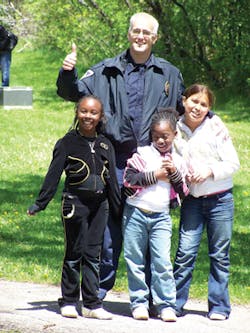
Policing is about keeping the peace, controlling crime and exerting authority for the common good. So, what happens when a traditionally conservative occupation resides in a place where a majority of the population leans far to the left? Eugene (Ore.), Berkeley (Calif.) and Madison (Wis.) all sit in counties ranked high in a liberal population. Each city's police department developed ways to not only work within its unique community, but work with the people they serve.
Eugene, OR
With a population of just over 150,000, Eugene is home to the University of Oregon, a thriving countercultural Saturday Market, and was the stomping ground for 1960s icon Ken Kesey. Remember the phrase, "Are you on the bus or off the bus?" Kesey's bus, "Further" made famous in The Electric Acid Kool-aid Test, still makes appearances here. Eugene is the largest city in Lane County, which landed as number 78 on the Daily Callers "America's most liberal-friendly towns" Top 100 list of 2010.
Eugene Police Department (EPD) has 183 officers and often faces showdowns in the media (particularly alternative papers) over a myriad of issues, including the use of electric control devices, a new headquarters being built outside downtown and dealing with disenfranchised populations like homeless youth. Through these media, it would seem EPD has a strained relationship with the community it serves. A deeper look into the department shows this is not the case at all.
"We have a chief that believes in community relations and meets on a regular basis with people from all walks of life in the community," explains Melinda McLaughlin, EPD's public information director. She agrees the liberal air of Eugene requires a different way of policing. "There's a higher level of scrutiny." McLaughlin states. "When you have a community with diverse political and social views, especially if they are polar opposites, there's going to be controversy."
Berkeley, CA
The oldest of the University of California campuses, UC-Berkeley, resides in this city of around 101,000. Once described as "in the running for the most left-wing place in America," Berkeley is a magnet for liberal-minded students and professors. Berkeley is located in Alameda County, which placed 25th on the Daily Callers list. During the 1960s, Berkeley earned a reputation, along with its neighbor San Francisco, as a place for social revolutionists to gather.
Berkeley Police Department with 181 officers embraces its history and retains policies and procedures reflecting the nuances of the era that defined it in the minds of many Americans. "Policing should be a reflection of what the community desires their police officers to be like and behave like, and be part of the community," Sgt. Mary Kusmiss, Berkeley PD's public information officer explains. "We have a counsel resolution against helicopters and dogs being used in policing, and those resolutions came from the era of when helicopters and dogs were used for crowd control purposes and not in ways we'd use them now."
Madison, WI
Another college town, Madison boasts a population of just over 231,000 and is home to the University of Wisconsin-Madison. Madison is located in Dane County, which placed an impressive number 8 on the Daily Callers list. Madison claims the title of being the "birthplace of the Progressive Movement." Often dubbed informally, The People's Republic of Madison, this town's political and social views fall well outside an expected conservative mid-Western ideology.
Madison Police Department prides itself in being on the forefront of community relationships. In this department of 438, from the time they step foot into the academy on day one, to the time they retire, officers are immersed in community-based, also known as "trust-based" policing as a philosophy, and not just a program. "We have a long standing tradition of four decades of being on the cutting edge of being able to look at what policing means to a community," explains Michael Koval, Madison PD's sergeant of personnel and training. "Community-oriented policing is not something we do to a community; it's something we do with a community." Like Eugene and Berkeley, Madison embraces three elements in maintaining good community relations: teamwork, transparency and trust.
Teamwork
The first element of working with a diverse population is teamwork. And having a diverse and educated workplace is key. "We reflect the community we serve," explains Kusmiss. "We have historically had a good complement of diversity in the department. We have very highly educated officers. At one point, we were the only agency to require a BA or BS." Madison also boasts a high degree of degrees. "We're one of the most educated departments," explains Joel DeSpain, Madison PD's public information officer. In the current academy class, 90 percent of recruits have a bachelor's or a master's degree, and the other 10 percent have an associate degree and are endeavoring toward a bachelor's. Twenty-five percent of Madison officers have a master's, and the department doesn't dictate what those degrees are in. "We feel when you look at achieving a diverse workplace it means getting people with all kinds of experience." Their degrees include disciplines such as special education, journalism, law, business, philosophy, production, as well as criminal justice.
Another key to teamwork is facilitating relationships within the community. "Each district has a community policing team," explains DeSpain. "They are able to tailor what they do to their community. We have a mounted unit and a K-9 unit that are both good ways to deal with younger people, and get them accustomed to talking with police officers and letting them know police officers are people they can trust. We use our community rooms quite often to invite people in to talk about things."
Eugene PD also participates in listening sessions. These sessions include 10-to-15 community members and 10-to-15 police employees from various divisions and levels. "They sit in a circle and each talks about their experience," McLaughlin explains. Communities including those of color, Asian-American, University of Oregon, Department of Youth Services and internal groups have utilized these sessions.
"These aren't short sessions," says McLaughlin. "They could take up to a day or a half day. It's a way to start discussions. The community outreach coordinator identifies people in the community who get invited. The framework helps build shared knowledge and builds new partnerships and relationships in a secure environment where everyone can talk."
Being a college town can have some additional challenges in developing teamwork. "(The students) question authority and institutional strength," says DeSpain. "These young people are learning and questioning and that is an important part of being a good community member. They keep us on our toes. We face crowd control and marches more so than a typical department. We are exceptionally proud of the fact that we are good at protecting First Amendment assembly. (We ask) how do we make this a win-win objective? How can you demonstrate your point to the public and how can we protect you?"
Transparency
The second element common to these departments is transparency. In incorporating electronic control devices (ECDs) into its police force, Eugene PD utilized this element well. "When new tools are introduced, it requires a lot more public interaction," explains McLaughlin. "There was unprecedented community input with roundtables where people could receive information and share input and concerns. These went through a police commission." With this framework, the department put together a pilot project. "We put out a news release every time the ECD was activated until people weren't covering it anymore and it was very transparent," McLaughlin says. "When we do those things, we maintain transparency. That's a process that in another town might occur quicker with not a lot of public input. In this community, the public input was necessary."
Kusmiss agrees transparency is important, but also points out limitations. "If you take the mystery out of things, then it minimizes the rumor and innuendo and conspiracy theories, but we do have to follow the framework of law and personnel rules," she states.
"The difficulty is sometimes on a particular issue there might be employment issues, legal issues or investigative issues that don't allow us to put all the facts out there for everyone to see." Madison's Chief of Police Noble Wray believes transparency needs to include the bad with the good. "The principle behind trust-based policing is to understand a person from their perspective, and making sure they are being transparent not only when things are going well, but when mistakes are made," he explains. "It gives the community a sense of what we can and can't do. I think it is equally important when things are going wrong and they can see it and see how an agency responds under those circumstances."
Trust
The third element in working with diverse populations is development of trust. This includes trust in the community and in the media. "You can't do this job alone," explains DeSpain. "You need to have trust in the community. It's a two-way street. If you are not putting out information, there's a break-down in trust, and if people don't trust you they aren't going to work with you to help fight crime." Kusmiss agrees, and also believes changes in technology, the Internet and social networking have created an even deeper relationship with the community. "At the end of the day, we create forums for neighborhood dialogue," says DeSpain. "We don't just send talking heads. We send the line officers, the sergeants who police in those neighborhoods. They're the ones the community sees, and we want the basic police officer and sergeant to be accountable, to hear first-hand what the problems are and bring them back. We aren't asking them to create world peace and harmony, but to look at the problems in their beat, document some and report throughout the course of the year what steps they are taking to help reduce the problem. It's the dialogue that promotes more community trust."
Trust in the media is also an important element. "We'll hold sessions where we'll invite all media together and talk about how our relationship is going and what can be done to work on it from both fronts," says DeSpain. McLaughlin believes traditional media is changing. "Newsrooms have become smaller with less staff that change more frequently. Sometimes you'll get a reporter who doesn't have a lot of background on policing or on the government, and they are putting out information to the public who also might not have the background, so (the reporter) need(s) to be brought up to speed more quickly."
Berkeley didn't have a public information officer until 2002. "We saw it as an opportunity to change culture internally and externally by developing mutually respectful and mutually understanding relationships," Kusmiss explains. "The internal process was more difficult to change. Then, officers started to realize the relationship was beneficial." As far as externally, Kusmiss states media personnel trust she will be open. They understand, "I will always tell you the truth and if I can't tell you the truth I'll tell you why."
"Working through crime, fear and disorder, you must have a mutual understanding of where the police are coming from and where the citizens are coming from," Wray states. "It's definitely a journey and not a destination. It could be one incident that sets you back and you have to be committed to continuously work on it." Teamwork, transparency and trust are essential to working with and in communities with ideology that strays from mainstream. "We have a real mix of people," says DeSpain. "We have million dollar condos in the same neighborhood as a halfway house and rental units with students."
In Madison's city center, numerous festivals are hosted such as Halloween's Freakfest and the Mifflin Street Block Party (born of the protest years). The area includes politicians, tourists, a transient population and students. If someone is going to have a rally or protest, it will be here. DeSpain concludes, "It's a challenge on a daily basis getting these diverse people playing nicely in the sandbox."
About the Author

Michelle Perin
Michelle Perin has been a freelance writer since 2000. In December 2010, she earned her Master’s degree in Criminology and Criminal Justice from Indiana State University.