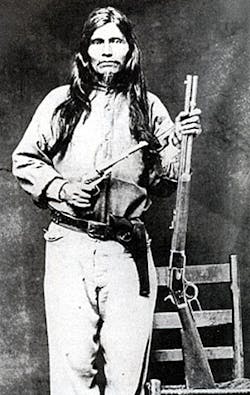
As I suspected, I received a few emails in reference to the story of Ned Christie reportedly swearing to kill last month's legendary lawman Bass Reeves. Apparently a few of you readers are true students of old west history because you mentioned that Ned was wrongly accused of his crimes and subsequently killed for no reason. So let me clear up this chapter of old west lore.
He was born December 14, 1852 to Watt and Lydia (Thrower) Christie, Removal Era Trail of Tears survivors at Rabbit Trap within the Going Snake District of the Cherokee Nation. Watt and Lydia were well to do and highly respected within the tribe. Ned grew up educated in regards to both Indian and the white man's ways. He was schooled by his father in the trades of blacksmith and gunsmith.
Like Bass Reeves, Ned Christie was a large figure, and being of high regard was elected a Cherokee Senator (also known as Executive Councilor) in 1885 during the administration of Chief Dennis Bushyhead. He was known on the Senate floor as a staunch advocate for Tribal Sovereignty, as agreed to in treaties with the United States. He was strongly against the railroads entering Cherokee Nation jurisdiction, as well as the impending allotment of Cherokee lands in severality to the Cherokee People.
The real story begins on Easter Sunday 1887 when a fire burned the Cherokee National Female Seminary in Tahlequah, Oklahoma. No one was injured as the head of the school, Florence Wilson, made sure all the girls got out. This resulted in Ned traveling to Tahlequah (then Capitol of the Cherokee Nation) to attend a special council meeting regarding the fire. During his visit on May 4, 1887, a U.S. Deputy Marshal named Dan (or Dave) Maples was killed.
Christie was accused of the killing and, upon advice from his father and other Indian elders, retreated back to his home in Wauhilla in an attempt to garner evidence in his defense. To make matters worse for Christie, Fort Smith Federal Judge Isaac Parker, known as the Hanging Judge, assumed jurisdiction since it was one of his white Marshals who had been killed. The chase continued for five years as Christie continuously evaded capture (much to the dismay of the Marshals).
During this time, Christie was known as the west's most hunted outlaw. He was accused of every unsolved crime in Cherokee Nation, from horse thieving to bank robbery. All the while Ned Christie continued to stand up for the sovereignty of the Cherokee Nation and vowed to never speak English again - only his own native tongue, Cherokee. None of this sat too well with Judge Parker (who felt he was being made a fool of personally) and he tasked Heck Thomas to forgo all else and bring Christie in, dead or alive.
Thomas pursued Christie for three months until he finally caught up with him. In the exchange of gunfire Christie caught a rifle round in the face, costing him an eye. This apparently wasn't enough to stop him as he escaped once again. The unjustly accused, once proud handsome man now had a disfigured face and even more reason to hate the white man. Thomas would soon learn that Christie was forting up for the winter. This term was accurate in this case as Christie and several other Indians were building a cabin in an open field (with an excellent field of fire). This was not your ordinary cabin. By all accounts with was built more like a safe. With two layers of logs filled with sand in between it could take everything the Marshals could deliver, or so Christie thought.
Parker assigned seventeen deputies to take down Christie. This number of deputies in one place was unheard of at the time, let alone to apprehend one man. They acquired a sturdy three-pound canon from Paden Tolbert. Tolbert not only brought his canon but a load of dynamite, just in case. On the morning of November 2 the battle began with gunfire, to no effect. The canon was put into service and once again the Marshals were disappointed. Only bark flew in the wake of the three pound ball.
A second shot produce much of the same. No effect. So the wagon with a full charge of dynamite was pushed close to the cabin and the charge was lit. This time the results were different. The cabin was destroyed into broken charred remains. In the confusion, one Indian escaped, one was killed, and Christie stepped forward rifle blazing. The Marshals opened fire and the battle was over. Ned Christie lay dead. The body was taken to Fort Smith, photographed and put on display. Watt Christie came to claim it and drove off to give it a proper burial in the Rabbit Trap graveyard.
Now, since the only suspect in the Deputy Marshal Dan Maples murder trail was dead, there was no trial. It was not until 1918 that the truth became public knowledge. In a story in the Daily Oklahoman it was revealed that Tahlequah blacksmith Richard A. (Dick) Humphrey, a former slave adopted into the Cherokee Nation, had witnessed the murder. Humphrey, on his way home from work on the night in question, had started across a footlog below the wagon camp at Big Spring. In the moonlight, he saw Bub Trainor stooped over Ned Christie, who was passed out in the bushes. Trainor took off Christie's dark jacket and slipped it on over his white shirt. With revolver in hand, Trainor stood behind a tree. Like many others in the town, Humphrey was afraid of Trainor, so he merely stood hidden from Trainor's view and watched. What he saw was the assassination of Maples. His fear of Trainer kept him from coming forward to exonerate Christie. Trainor died in 1896. He was, according to one newspaper report, killed at Talala on Christmas night, by 4 negroes. It was a plot, and 4 shotguns did the work.
Humphrey still did not come forward as he was afraid of Trainor's gang and waited until he was 87 years old to tell his story to Daily Oklahoman reporter, 26 years after Ned Chrsitie's death. As with many stories from the old west, details sometimes get lost "in the mix". In this case, the facts - as reported by historical record - seem to mesh. When Bass Reeves was part of the posse pursuing Christie, all evidence and testimony seemed to support the capture and arrest of him. It wasn't until some time later that Christie's innocence was established.
About the Author

Charles Bennett
Charles Bennett was born in our Nation's Capital and grew up in the Maryland suburbs. Mr. Bennett has been working in all aspects of the publishing industry since the late 1980s primarily in the fields of commercial photography and magazine production. Moving to California in 1992 to attend college resulted in B.F.A and Masters degrees. California also supplied Mr. Bennett with his wife. The two of them are avid sports persons and participate in shooting, scuba diving, surfing, running and bicycling. As a long time hobby Mr. Bennett has studied the legends of American law enforcement which led to his writing these columns.