The software suggestion box
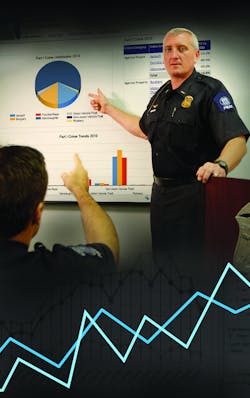
We all recall the retail business mantra “the customer is always right.” Well, while this may not always be true, the customer today has a huge voice in how law enforcement products are designed. Software is a prime example of this trend, and records management systems (RMS) in particular are now a reflection of carefully sifted customer feedback on a product’s feature set and functionality.
Of course, feedback can be a double-edged sword---more suggestions, ranging from sensible to impractical, for product improvement than can ever be accommodated, contrasted by the need of vendors to adopt those suggestions that will benefit all software users. Striking this balance makes the effort to continually improve RMS software a steady work in progress.
Meanwhile, many suggestions for new RMS software capabilities make sound sense.
Not just RMS
That’s what Crimestar Corp., which offers RMS, CAD and mobile data communications software systems for predominantly small to mid-size police departments, discovered when customers suggested, for example, that a Vehicle/Fleet Maintenance module be built into the company’s RMS system.
“It was always my view that there are many vehicle maintenance programs out there, some of which are free, so why should we re-invent the wheel by adding it to Crimestar?” mused company president Alec Gagne, who also is a former police officer. But he soon heard from customers why he should change his thinking.
“ Most customers wanted the RMS system to be a complete department information management tool and not just an RMS (program),” Gagne continued. “They did not like the idea of having a separate program to keep track of vehicle maintenance issues. That’s why we have capabilities in Crimestar RMS like Vehicle Maintenance, Key Control and Department Asset Inventory.”
At first glance, these features may not seem directly relevant to law enforcement records management. However, Gagne asserts, “Customers wanted them included in the RMS rather than using a separate program for those specific tasks.”
This kind of one-stop shopping approach to RMS software is particularly appealing to small police departments, argues Eric Sargent, a former police chief and Crimestar’s National Sales Manager. “Departments cannot get overburdened with too many modules (in an RMS program or as entirely individual offerings),” Sargent said.
Most of the suggestions Crimestar receives for its software are not for new modules, but for tweaks to existing ones. Unless there is an interface requested by a customer, Crimestar does not charge for new software improvements. The company’s annual RMS System support charge of $300 includes all updates and unlimited technical support.
A more formal response to the RMS “suggestion box” is taken at New World Systems. According to Mark Prevost, the firm’s vice president of marketing, a highly structured software improvement suggestion process is the foundation for much of New World’s RMS software functionality and modules that are built.
Software Partially Built, Then ‘Show-and-Tell’
“We use a process called Agile Development, where we take suggestions from groups of customers to make sure we understand what their vision is,” Prevost explained. “We build part of the software with newly recommended capabilities, then pause to do a show-and-tell (with customers) before finalizing the solution.”
The best specific example of this process, Prevost continued, is a module in New World’s RMS software called Decision Support. The rationale behind the module is that because there is so much data flowing into numerous records there has been no effective way to convert the data into what Prevost calls “actionable intelligence.”
So, just how does “Decision Support” work to help law enforcement agencies? Prevost poses an example. “Let’s say a police department wants to measure certain crimes by geographic area, day of the week, time of day, so that they can staff certain beats of patrols accordingly,” said Prevost. “ If I know, for instance, that I’ve got crimes occurring at a specific chain of convenience stores at two o’clock in the morning on Saturday nights, and there’s a real rise in incidents and frequency of these, as a command person I can staff accordingly to apply the right patrols to that area.”
Prevost said the upshot here is that New World’s Decision Support module in its RMS program allows law enforcement customers to query a database and use that information to answer key questions. As a result, crime trending and statistical tracking can occur. “This is aimed not just at fighting crime,” Prevost said, “but also at reducing it.”
Customized Report Forms
Another RMS software maker, TriTech Software Systems, learned from its customers that having all files associated with any one case is a high priority. Therefore, files containing video, audio and PDFs can be attached in one place.
TriTech makes two RMS software products—VisiNet Solutions for large public safety agencies, and Imc Solutions for small to medium-sized agencies.
Numerous police departments have requested a capability for devising customized report forms, which the software now offers. According to Leo Hisoire, TriTech’s Vice President of Operations, these forms are normally created in Microsoft Word.
“We have a function where data from the case can be populated in that Word document, then saved as an attached file for later reference,” Hisoire said. State data sharing programs include NJ-Dex in New Jersey, SWISS data share in Massachusetts, OLLEISN in Ohio, to name a few.
Hisoire added that TriTech currently is developing a Lynx interface with Northrup Grumman for NCIS. “Our real-time data sharing program allows departments using our Imc Solutions software to instantly see what other Imc departments have on a person using a federated query,” he said.
Two other RMS software providers serving mid-sized to large public safety agencies—Intergraph Corp. and Spillman Technologies—also have innovative protocols in place that allow for specific customer feedback on desired changes or additions to RMS software.
Help sought to prioritize RMS solutions
Intergraph Corporation, for example, asks customers to complete a survey form so they can indicate what kinds of enhancements are needed. Customers can log suggestions on the company’s website as well, and these become part of the survey results.
Intergraph also wants to hear from senior ranking officials within its customer base, so it recruits a few of these customers to serve on a kind of steering committee. “We get them to help us prioritize what are the most crucial areas of focus in public safety solutions we offer,” explained Steve Marz, Vice President of Intergraph’s Public Safety Management Division. “We want to make sure we have something that is meeting the needs of customers today, but also that is going to address trends and the direction we see the industry moving.”
According to Terry Shoemaker, Public Safety Manager, Law Enforcement Records and Jail Management, for Intergraph’s Government and Infrastructure Division, the company’s software is designed so that it can be “taken out of the box” and used immediately. Oftentimes, however, Shoemaker notes that customers will want changes made to their Intergraph software to fit the specific needs of their agency.
“Our customers have the ability to see what already has been requested for software changes and additions, and to indicate that they also are interested in these as well,” Shoemaker said.
Intergraph soon will unveil two new product versions of its RMS software. Between them there will be a new field reporting version, a permits module, DUI report capability, data transfer between modules to avoid duplication, and improved ability for attachments so that they have better security when traveling across a network that encrypts the attachments. Finally, there will be a feature to allow data collection for crime scene evidence directly in the field.
Spillman Technologies holds an Annual Users Conference where customers can meet directly with the company’s product line managers to speak their minds about RMS software improvements.
Customers vote; best ideas chosen from a ‘gold’ list
Customers are invited to go a step further with voicing their opinions on needed software enhancements. Says Carrie Brown, Spillman’s Marketing Communications Supervisor: “Customers can vote online for each product enhancement during scheduled periods, and learn more about the voting process. Customer agencies are assigned a number of votes to use each year.”
The company’s Research & Design Department reviews and categorizes submitted enhancements at the start of each new year, then places them on a ballot for the first round of annual online voting, called the “Long” List. The goal of this list is to reduce the ballot from nearly 200 to approximately 50 enhancements, with four to seven in each of the company’s 10 primary categories, Brown explained.
The recommended software enhancements that receive the most votes go on to the second ballot, called the Short or “Gold” List. “This second round of voting determines which enhancements will be added to Spillman’s RMS product suite,” Brown said.
One of the most recent new products that has resulted from customer suggestions is Spillman Touch™, an application for mobile devices, including the iPad, that allows a user to access records and images, search for data, view dispatch information, and receive call assignments. The product is expected to be released at the close of this year’s first quarter.
Special requests granted -- for a price
When does a customer suggestion for a software enhancement become something much bigger? This is an issue faced by all RMS software makers. And it usually involves more money from the customer.
Intergraph’s Steve Marz says his company’s software is highly configurable. “We do an implementation program for every customer, and determine how much customization the customer needs and can afford,” Marz said. “There are times when somebody has to have something (an improvement) that nobody else is interested in. When this happens, we will build it for an extra cost, but we will probably fold it into the core product because it becomes a maintenance problem otherwise,” Marz added.
Ditto for the other RMS software vendors mentioned above.
Modules that are custom built at one customer’s request typically will cost that customer extra money. “But it has to be a different type of capability,” said Marz on behalf of the Intergraph products.
A very similar customer feedback process is applied to Computer-Aided Dispatch systems for these and most other public safety records management software providers.
Software upgrades among most vendors are usually part of a maintenance contract that is sold separately from the software’s purchase. And some vendors charge for implementation of these upgrades as well as for entirely new modules.
Improvements hinge on level of customer interest, future plans
Crown Pointe Technologies, which offers Academy, In-Service Training Management, FTO and PTO Field Training, and other public safety software, takes a slightly different approach to soliciting and implementing customer feedback in its products. A recommended software improvement simply has to make sense, according to Charles Lowry, Crown Pointe’s president and CEO.
The number of customers who would be interested in seeing a suggested improvement implemented is a key factor that must be considered.
“We check with our best customers who use the software extensively,” Lowry explained. “And we ask if a proposed improvement would add value to their current operation.”
Finally, Crown Pointe Technologies wants to know how big of a need a suggested new capability for its training software will meet for a customer’s future plans.
One feature customers asked Crown Pointe to add to its Equipment Management Module is the ability to track a history of firearms and vehicles issued to officers and equipment issued to vehicles. For example, in the company’s firearms/equipment/vehicle management module, users can now click on an icon and see all the firearms issued to any one officer or to a vehicle.
The software’s Document Management module began merely with a feature to document training officers’ performance reviews. Now, it can control images, PowerPoint presentations, video clips on officers’ field activities, and provide external links to websites.
One of Crown Pointe’s user departments incorporated the Document Management module into its state records system, and today this certified system has eliminated the need for any more paper documents.
The use of graphics is another hot feature that Crown Pointe has incorporated. Bar graphs, for example are helpful for tracking officers in training and comparing how well they do during the course of their instruction.
Although today’s RMS software, regardless of the vendor, is packed with useful functionality and feature sets, there is a flipside to the gusher of customer feedback that will no doubt remain uncapped. That is, how much of any of these software’s content gets fully used?
Eric Sargent, the Crimestar national sales manager, has his own recommendation, which is that every law enforcement agency conduct a job task analysis. Such an analysis might prompt agencies to resist changing the ways they handle their records. Concludes Sargent: “Look at everything you’re doing and why you’re doing it that way. There’s probably a better way to do it, and that better way may be right in the RMS software you have.”
About the Author
Robert Galvin
Robert Galvin is a freelance writer based in Oregon City, Ore.