TV whitespace broadband makes video surveillance possible in impossible topography
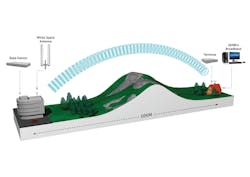
Video surveillance serves to report crimes and protect officers in the field, allowing officers to detect situations in remote areas and determine how to enter. Video is essentially police awareness, extending the eyes and the capabilities of law enforcement. But what about those areas where cameras can’t be deployed because of obstacles that prevent line-of-sight for microwave solutions?
A long-awaited broadband communications alternative is here, one with non-line-of-sight (NLOS) capabilities that make video camera backhaul possible in the most challenging locations—TV white space broadband.
White space is the term for unused TV spectrum. White space became available when television broadcasts transitioned from analog to digital. Recently the FCC designated this unlicensed spectrum for broadband use. This means that wireless Internet service providers (WISPs), municipalities, public safety agencies, and many others will have the advantage of using vacant TV channels to deliver service to previously unreachable rural areas at a lower cost.
By harnessing the NLOS capabilities of TV white space (TVWS) frequency bands, service providers can now deliver speeds comparable to traditional wireless networks (up to 16 Mbps over the air in the current generation). While the range varies depending upon the terrain and obstacles in each individual location, users can typically expect an area of high throughput extending 3-7 miles from the base station.
Up until now, the focus of this new technology has been rural deployment in order to deliver high-speed Internet connection to underserved regions, which is particularly important in the public safety arena. Although this still remains the primary purpose, the ability to improve wireless connectivity is expanding to many other applications. Wireless deployment of video surveillance networks has become a hot topic. Surveillance cameras are being used everywhere, from shopping malls to parking lots. And now, thanks to TV white space, cameras can be deployed in more secluded locations like forested greenbelts and hidden alleyways, improving security for officers and community members.
Getting broadband to challenging locations
Carlson is one of the few companies leading the charge toward turning TVWS broadband into a reality. Carlson’s award-winning RuralConnect broadband radio system enables the signal to surpass almost any obstacle due to its propagation characteristics, which are able to operate with large amounts of multipath interference. Additionally, Carlson has partnered with TVWS spectrum manager, Spectrum Bridge, in order to ensure a seamless, interference-free network.
The two have been collaborating to find a way to make the technology viable for broadband communication. Craig Domeny, Carlson director of engineering says, “This spectrum, which opened up when TV became digital, is a luxury no one had five or even three years ago. The non-line-of-sight propagation is a characteristic of UHF spectrum, making it ideal for broadband in challenging locations. The design of the radio is focused around achieving high data rates and equalizing multipath and fading effects for NLOS communication.”
Using white space for video
With data rates to support high-definition video, Carlson’s RuralConnect can be used to create point-to-point or point-to-multipoint networks with priority-routing support for voice, data and video traffic. Its numerous applications extend to IP video surveillance and traffic monitoring. The dynamic broadband radio utilizes the superior TVWS spectrum to deploy campus-wide, citywide or regional wireless video surveillance systems and wireless broadband networks in a cost-effective manner.
Although public safety agencies will benefit from TVWS “indoor broadband access” in many ways, including the ability to supplement emergency communications, offer online officer training, access critical data resources and more, they can now add “outdoor broadband access” to the list of TVWS benefits. First responders can use the network to manage their outdoor video surveillance systems via broadband security cameras.
Video surveillance and law enforcement go hand-in-hand; this network can be deployed in a variety of configurations to extend Wi-Fi connectivity and video surveillance to city parks and university campuses, provide additional security for hospital grounds and government buildings, on city streets to mitigate and manage traffic, while protecting citizens and property over all. City management improves decision-making by collecting and analyzing the data in real-time via advanced monitoring systems and smart sensors. Homeland Security efforts include video surveillance in remote locations like water storage reservoirs, nuclear power plants, airport perimeters and military bases.
White space video in action
A recent example of a TVWS broadband video surveillance system was installed in Wilmington, North Carolina. The system’s main function was video surveillance in community parks. Not only is this technology unobtrusive and environmentally friendly, but it protects citizens and park visitors while affording staff more efficient ways to manage each location. But the primary objective of this new system was to create a “Smart City” that integrates video surveillance, security and traffic management, maximize energy efficiency, and enhance public safety.
The City of Wilmington’s originally intended for city officials to use the video surveillance to monitor and secure its community parks and facilities. It soon evolved into a public service for the community in which residents had access to public Wi-Fi and the ability to view, for example, when the flowers were blooming or the size of the crowds before planning a visit. The Spectrum Bridge shared-spectrum platform ensures the radios are operating on the best available frequency for the highest performance and quality of service, which is important in a Public Safety environment.
“Spectrum Bridge is unlocking the value of spectrum by enabling high-speed, low cost bandwidth across wireless applications with its unique, patented spectrum management technology,” said Rod Dir, CEO of Spectrum Bridge. “We are excited to see how local cities across the country are exploring innovative technologies using TV White Space to provide additional services to the community.”
Improved safety for officers
TVWS broadband technology gives officers more efficient ways to manage locations that don’t have line-of-sight. The lower frequencies of the unlicensed TVWS spectrum reduce the need for line-of-sight (LOS) links, which allows for lower antenna heights and longer ranges. TVWS digital video monitoring can be effectively implemented in alleys and far sides of buildings, outskirts, secluded pockets of downtown areas, and other NLOS areas without degradation of signal.
Even where there are “black holes” for communication, or where handheld devices won’t work, law enforcement can still have video surveillance. Radio communication black holes are a matter of life and death, particularly for rural communities. Even in cases where statewide radio systems are installed to allow intercommunication between emergency personnel, some towers may not be able to supply the coverage needed in heavily forested, mountainous, or rugged areas. This creates big, black holes where emergency responders have no radio coverage, let alone security video or traffic surveillance. Thanks to the advent of TVWS broadband and Carlson’s RuralConnect, municipalities and public safety entities can fill the gaps in coverage, and secure the perimeter using surveillance cameras.
IP cameras can be used with this new TVWS bandwidth for an excellent NLOS solution. Most IP-based cameras feature dual video streams for high and low resolutions. Many public safety applications require high-resolution images and high scan rates, while in other applications, such as monitoring of critical infrastructure or construction sites, lower resolution and frame rates are acceptable.
Surveillance where it’s needed most
“TV white space technology allows for tactical deployment of wireless surveillance,” says Kiely Cronin, Carlson sales engineer and TVWS product specialist. “Because the system doesn’t need extensive infrastructure, it can be quickly deployed where it’s needed.”
One of the most frequently asked questions about TVWS is how to find out if it will work in a specific location. Although site surveys are not necessary, a Carlson engineer can quickly determine the available channels in a location and perform a detailed propagation study, which provides users with an approximation of the coverage, range and signal strength they can expect from the RuralConnect.
When it comes to using wireless technology for challenging terrain, there is no faster, more reliable or cost-effective way to connect via Internet or to deploy a security surveillance system than through TVWS broadband.
About the Author

James Carlson
CEO
James Carlson is the CEO at Carlson Wireless Technologies, a California-based company that designs and manufactures wireless equipment for broadband and backhaul. Carlson is a radio engineer with more than two decades of experience developing rural connectivity solutions.
He can be reached through the company’s website: www.carlsonwireless.com.