Look Sheriff: Bubba's Flyin'!
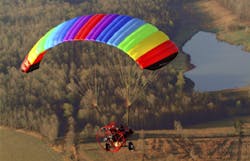
Imagine telling your Sheriff that you could start up an aviation unit for under the price of a patrol car, with a few hours of training and the ability to access your aircraft at a moments notice. Yes, with a little training, even Bubba could be your department's pilot in command.
Well, that's exactly what the powered parachute industry is doing for many.
As a single engine, fixed wing pilot with a little over three hundred hours, I can sympathize with the concerns of agencies proposing an aviation program. To put it bluntly… it's dang expensive. The last time I went flying for the day, motivated by the phrase, "what's in your wallet", it was quickly followed by, "she's going to kill me when she sees this month's credit card statement". However, the ability to conduct cost effective aerial operations of illegal plant growing, search and rescue, accident and crime scene investigations and fugitive apprehension, has just become a reality.
Powered Parachute
Although a powered parachute slightly differs from manufacture to manufacture, the basic design is the same. A soft winged, aerial vehicle that combines an engine with flexible parachute wing technology or, in laymen terms, a parachute with a motor and wheels. Depending on engine, machine and canopy size, shape and design, the airspeed is typically about 25-35 mph and can operate safely at heights ranging from a few feet off the ground to altitudes as high as 10,000+ feet. This makes a powered parachute ideal for skimming across the canopy of the woods, a field or anywhere a lab or grow operation could be hiding. I will be the first to admit, a powered parachute is NOT a speed demon or something you are going to watch in amazement as it blasts by. But in the grand scheme of things, 25-35 at take-off, in flight and landing is perfect for LE operations.
Most manufacturers I have researched over the years, equip their machines with a 5 or 10 gallon fuel tank which they advise equates to 3+ hours of flying depending on machines specifications, weather conditions etc. There is also no need for trips to the airport to fill up as most powered parachutes use mid-grade or premium unleaded gasoline that you purchase at your local filling station. This adds up to approximately $4.00 an hour.
Operations, Deployment and Transport
Another added bonus for some agencies will be the fact that the powered parachutes base of operations can be very mobile. These aircraft have a very short take-off and landing roll, ranging from 100 to 500 ft. (depending on, weather, gross vehicle weight, type of chute and the need to climb over obstacles) and allow the location(s) of deployment to be almost limitless. For the beginner, training in a powered parachute is very basic with only 3 fundamental flight controls and its virtually impossible to roll, stall, loop, or dive when you fly the aircraft in proper, safe flying conditions. Best of all if, in the unlikely event your engine quits, simply parachute slowly back to the ground.
There is no license required to fly a single place model (FAR 103 and the 6080 Exemption); however, there are requirements to fly and take passengers on two-place models. Transport of a powered parachute is as diverse as the initial selection of one. Trailers, trucks, vans etc. are all acceptable modes of transport depending on the machine. Many companies sell trailers specifically for powered parachute enthusiasts. From a law enforcement standpoint, I find covert would prove to be best as to not give the bad guys a heads up on our operation. Although I am comfortable that our "repeat customers" are not the brightest stars in the sky, most would notice that the POLICE have just drove by with what looked like an "Areo plane" in the back of their "pick'm up truck".
The Burning Question-How Much
Alright, the burning question... cost? Growth of this industry has caused an "explosion" of manufactures and equipment to select from. As a general range, a new powered parachute can cost anywhere from $5,000-$25,000 but still offer the most affordable flying available. Although this may appear to be a large gap in numbers, during my research I found that there are currently more powered parachute manufacturers in the US than automotive makers. Buckeye™, (based out of Argos, Indiana) is documented as being known as the oldest and largest manufacturer of powered parachutes in the world, catering to both the US military and NASA but I suggest doing a Google™ search as I was able to find numerous manufacturers and dealers throughout the nation.
Final Thoughts
With the rising cost of fuel prices and many air units being inundated with calls to service or grounded due to costs, the powered parachute (in my opinion), is a smart, realistic and obtainable solution for a department willing to be creative and the desire to come up with innovative solutions to old problems.
On a final note, I am sure that there will be small few who read this article and ask the question "Why would anyone in their right mind, strap a fan to a lawn chair and buzz around the sky?" These are the same folks, who for years, have asked me, "Why would anyone in their right mind, jump out of a perfectly good airplane" followed by "There is no way I would fly in one of them little planes". It is to these folks I simply reply, "Don't".
To the remainder of us who run towards the house as we hear shots fired and put our lives on the line before others, I say to you this: Not only is this a great tool for law enforcement, but imagine the cool factor as your buddies sit in their patrol cars when you are buzzing the tree line with the wind in your face and a grin from ear to ear.
Go Bubba Go!!!