Violent intruder training - Evolution
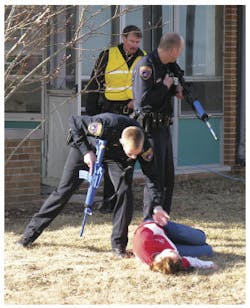
The laid on the ground outside, quiet and still. She had curled herself up; her knees brought close, offering false comfort. The fall had hurt. There was no time to brace herself — she needed to get away.
He frantically ran around, not giving the girl one more glance. She was no longer the girl that got him arrested earlier. He was barely even yelling then, he thought. At that moment he had other concerns: His remaining classmates emotionally frozen inside; some of them ran — campus safety was sure to be on its way; the local police department after that, and later, SWAT.
It was just him now — him and his blue plastic pistol.
A popular tactic to help train for active shooter events is to produce active shooter training scenarios. Intruder response training has become a regular practice for many campuses, school districts and law enforcement agencies, yet can present responsive options for the community as well.
Located off the shore of Lake Michigan, the Concordia University Wisconsin produced their first-ever training for an active shooter situation late March 2009. The scenario included the University's campus safety department, law enforcement, county SWAT, the Department of Emergency Preparedness: Office of Emergency Management, the local hospital and high school as well as a few acting students from the University's theatre department.
Starting a long period of planning, Concordia University Wisconsin had begun the event's preparation in response to the tragedies of Virginia Tech and Northern Illinois. While careful tactics were carried out, the training revealed more about communications than was previously considered.
"Each time there was a new disaster shooting, such as Virginia Tech and Northern Illinois, we attempt to learn from each incident," says Mario Valdes, Director of Campus Safety of Concordia University Wisconsin. His department tried to learn what some of the deterrents were and the things those responding would have done differently in hindsight.
To Valdes, it was communications. "Some were lacking communications and lacked educating the public — the students and staff — to look for certain signs and then to share that information," he says.
Other universities conduct similar active shooter training events. The University of California (UC)-Riverside has performed shooter training for two years so far; the 2009 summer will mark their third year. The UC-Riverside Police Department (PD) training takes place each June in and around a vacant residence hall on campus. They include participation from the City of Riverside Police Department Metro (SWAT) team and bomb squad.
"The first year that we did training, a Lieutenant with the Riverside County (California) Sheriff's Department that had been to the Virginia Tech debrief provided a summary of what was talked about — the lessons they learned about when you find doors chained up and alternatives for breaching through windows," says Lieutenant John Freese of the UC-Riverside PD.
As planning of the Concordia University Wisconsin event continued, the pre-conceived notions of a tactics-only event changed. "[Ultimately] it was an exercise in communications and how well we communicate with Concordia University Wisconsin, its security, the fire department and with emergency management," says Captain Daniel Buntrock of the Mequon, Wis., PD. He explains that during the planning, the organizations involved started to understand each other's needs, concerns and the reasoning behind each other's actions.
In an attempt to create a realistic simulation, Concordia University Wisconsin used Blue Guns to simulate firearms, civilian and officer alike, a temporary radio dispatch set up on campus for the scenario's use only as well as video cameras to record the action.
To achieve the same realistic experience, UC-Riverside utilizes Simunitions in its active shooter training and records the action with handheld cameras.
"Every year we try to improve … last year we actually chained the doors where the scenario shooting took place. Officers had to physically take a bolt cutters and cut through the chain to breach the door," adds Freese. The recordings, he adds, provide a low cost real-time way for constructive criticism for the officers, proving helpful to see from the camera's perspective.
Similarly, Buntrock saw potential for the Concordia University Wisconsin training to be more than a tactical exercise. He wanted to know how the participating organizations were able to work together. "I was more interested to see if the officers and dispatch were asking the right questions and communicating properly — trying to see where we were weak and where we were strong."
Educating/training the public
One aspect within communications is education. In its effort to educate its community on safety, the UC-Riverside PD provided guidelines for how to respond in a crisis. Developed about two years ago, its paper "Safety Tips & Guidelines regarding potential 'Active Shooter' incidents occurring on Campus" defines an active shooter and offers tips on actions based on location and situation. These guidelines are based on the RAIN program (Respond, Assess, Isolate and Notify) created by the University Crime Watch organization. A disclaimer reminds readers that "these safety tips and guidelines are not all inclusive, but if understood and followed up with periodic reminders and training when feasible, it can increase your chances of surviving an active shooter incident."
Understanding that each situation is unique, the nation has seen another aspect to combine with training its officers and tactical teams: professional teachings and training geared towards the community.
The concept of "lockdown" as a response for students, workers and church members has been to "prevent access from an intruder," says Vaughn Baker, Strategos International's president. New ideas teach the public that they may have other choices to aid their survival in the event of a violent intruder situation.
As a former SWAT officer, Response Options owner, Greg Crane asks, "What are the potential victims doing to maximize or increase their odds of survival? While law enforcement are on their way, they [police] can't be there immediately, what are you [civilians] doing to maximize your chances of survival?"
Response Options offers education of just what their name implies: knowledge of the alternative choices along with lockdown, until help arrives. Crane adds that "We [Response Options] thought securing in place as the only tool was inadequate and unrealistic."
Educating the public in a similar fashion, Strategos International provides law enforcement and the public with active shooter response training in specifically designed programs. Courses such as Interfaith Intruder Response, School Intruder Response and Workplace Intruder Response teach its participants about the options in response to a violent intruder. Strategos also provides small and larger agency law enforcement with operator and instructor courses as well as a course designed for the school resource officer.
However, these courses are not to be misconstrued as in opposition to the lockdown concept. While the lockdown remains an important option in the response to an active shooter or violent intruder, these ideas are meant to enforce that there are other options available.
Buntrock reminds that, "Every scenario is different."
Both Response Options and Strategos International offer a central process in their teachings built in the public's point of view.
"We have got to convince people that if their life is worth fighting for, then maybe they need to fight for it," says Crane.
He sees "fight or flight" with a third option: freeze. With the latter two an uncommon part of a school's procedures, the choice must depend upon the situation. To assist this Response Options provides its ALICE (Alert, Lockdown, Inform, Counter, Evacuate) program.
The Strategos International staff teaches a "three-out" principle: lockout, get out or take out. "Most schools and districts have plans in place already for lockdown and how to conduct a lockdown for their school," says Baker. "Almost no school has a plan for what to do when a lockdown fails.
"There has been a lack of understanding of what a lockdown is for," he continues. "A lockdown is meant to prevent access. Because we've never trained beyond the level of a lockdown, we didn't know what to do when the prevention of access failed."
While Freese agrees that any organization should develop guidelines for how to respond in a crisis, he notes that "civilian methods of hands-on intervention with attackers should be very general and described as a last resort."
Valdes sees the value in education. "You can't have the perfect plan, but at least it alerts you and gets you ready to think about the what if's," he says.
Editor's Note: University Crime Watch campus safety resources can be found at www.universitycrimewatch.org. The UC-Riverside RAIN Guidelines can be found at police.ucr.edu/crisis_response.html.
How to react
• Strategos International's three-out principle includes teaching how to lock and barricade doors. Vaughn Baker, president of Strategos International, explains the remainder of three-out principle by taking the point of view of a potential victim. "If my lockout hasn't worked, how can I get out of the location I'm in to get away from the intruder?"
In a true all-else-has-failed fashion, the take out principle uses "fight" as a last resort option. "If lockout has failed and I can't get out because I'm on the second or third floor, now I have to fight," he explains.
Strategos's courses then talk about using the victim's environment to their advantage. "What do I have around me to help me fight this person? What can I do to inflict damage onto the intruder trying to kill us?"
• Response Option's ALICE (Alert, Lockdown, Inform, Counter, Evacuate) program teaches what actions are available for victims based on vital knowledge gained during the situation.
Alert (A) transcends the announcement of a code word for securing doors and barricading. An advocate of options, Crane wants to give people choices so they can make a decision as to what they need to survive.
"That decision is going to be based on information," he says. He explains that if an institution is able to announce a code word, they should also be able to get out information such as what, where, who and any other details, and use them to make a good decision as to whether they should lockdown or not.
Inform (I) broadcasts updated information as the situation progresses. He suggests utilizing, if installed, the surveillance camera system to watch the situation.
Counter (C) offers simple strategies in using tactical advantages to aid survival, including swarm, limb control, take-down and distractions.