Toxicity in arms trafficking
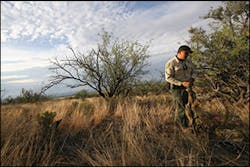
Nobody answers the door of the cinderblock home in Santa Ana, a crossroads town in northern Mexico. Indeed, there aren't many people walking the street in the growing heat of the desert morning.
Last spring a bust went down here, so big it left cops on both sides of the Arizona border cold. In the torrents of a war that has embroiled Mexico, it takes large events to startle people who live with it every day. Cartels have fractured, thousands of people have died, rolling gunfights every day, drug gangs trying to outdo the other's atrocities. Yet even in this new theater, the story is still talked about months later.
It went down in April. With a slight smirk on her young, smooth face, Anahi Beltrán stood between two federal police in black ski masks, her husband's arsenal spread out in front of her, looking like the weapons cache of some tribal warlord. But this isn't Somalia; this is Mexico. And the heavy artillery isn't being used to defend some faded ideology, but a business that tops $58 billion a year.
An M2 Browning model .50-caliber machine gun mounted on a white Ford F-150, a homemade turret welded to the frame. A .30-caliber rifle, a Barret .50-caliber rifle on a bipod, a modified AR-15, a 30-30 rifle, parts for a 37mm grenade launcher and a couple of AK-47s, along with about 9,000 rounds and a pound and a half of cocaine.
Related by blood to the leader of one of the Sinaloa cartels that dominate this region, the 20-year-old woman made the mistake of being home when Mexican federal agents descended on her home last April. Her husband, Jose Martinez, had escaped a half hour before the cops arrived, "departed the residence," in the vernacular of a Drug Enforcement agent speaking on condition of anonymity.
The arrest was an inside job between U.S. and Mexican agents. An informant leaked the couple's propensity for weapons to the Americans and they in turn reported it to the Mexican Army, who seemed mistrustful enough of its northern border forces that its leaders sent in a crew from Mexico City to make the arrest. Beltrán now sits in a prison in northern Mexico.
Positioned at the intersection of two major Mexican highways, Santa Ana is an artery for the movements of three warring cartels, one led by Joaquín "Chapo" Guzmán Loéra and his rival, Arturo Beltrán Leyva, here in Sonora. The Juárez Cartel, 5 hours east, uses it too. The conflicts manifest themselves in body counts and gunfights. The two highways form a trinity of legitimate commerce, human smuggling and drug trafficking. An hour west along Highway 2, a group of killers kidnapped four people then laid siege to the headquarters of the state police, the gunmen popping up from the sunroofs of matching Yukon SUVs. Then someone took a chainsaw to the bodies of nine men now laid out in a coroner's vault, a pile of legs and arms and heads sitting to the side of the bodies, waiting for a match. One hundred miles northwest, in a sweeping vista of luminous cholla and saguaro cactus, someone else specializes in smuggling Chinese nationals.
The longitudinal Highway 15 forms the other half of this backdrop, a NAFTA super-highway that connects to Interstate 10 in Arizona, the distribution hub for most of the United State's drug habit. The pattern is clear; the dope takes to the northbound highway. The migrant smuggling moves laterally, east and west along the border. The competition is fierce, sometimes brutal. In Juárez, where Guzmán's cartel battles the staid Juárez cartel, 200 people were murdered in the month of June alone.
And always, there are the guns.
Phoenix, Ariz.
William Newell, Arizona's special agent in charge of the Bureau of Alcohol, Tobacco, Firearms and Explosives, shows a map his office has drawn up of the various cartels and the routes they take to the border. Gulf Cartel to the east, then Juárez, the Sinaloans, then the Arellanos into San Diego. A set of colored arrows, one for each cartel's piece of real estate, points north. More arrows, these for the gun routes. "It's the same," he says, "the arrows are just pointed the other way."
With its liberal gun laws, Arizona is at the heart of the storm. Unlike most states, the popular semiautomatic rifles, AK-47s, AR-15s, are easily purchased with little more than a driver's license and some forms. The large caliber rifles, like those Beltrán stored, are also for sale.
But nobody can explain how a .50-caliber rifle can be driven down to the Mexico border and then crossed over.
The ease with which guns can be purchased in this state incapacitates American law enforcement, whose officers at times can only stand by and watch.
Consider the case of George Iknadosian. When Iknadosian was arrested, police tried to paint a portrait of a nearly archetypal arms dealer instead of the mere gunstore owner he claimed to be. State prosecutors argued that the Egyptian-born businessman moved to Arizona after the federal assault rifle ban sunsetted, and then sold hundreds of weapons to the Beltrán Leyvas family. Between March 2007 and 2008, prosecutors say Iknadosian sold 711 weapons that were used to commit crimes in Mexico. They also say Alfredo "El Mochomo" Beltrán Leyva had one of Iknadosian's pistols tucked into his belt when he was arrested in Sinaloa, and that the diamond-studded map of Sinaloa on the gun butt of a narco-syndicate on the Mexican border cost $35,000. They argued Iknadosian's employees sold the guns on the streets of Mexican border towns, and these guns were used in an attack in Sinaloa where eight federal police were killed.
The officers "ran out of ammunition in the fight," Newell says. "They got overwhelmed."
But in April, a county judge threw the case out before it even reached the jury; the buyers were eligible to buy the guns and as a result, Iknadosian's sales were legitimate. Whether his guns were found tucked into the waistband of a crime boss or used to blow away eight officers was of no legal concern. Newell stirs at the point.
"Iknadosian was coaching undercover ATF agents on how to avoid being detected," he said. "He admitted he knew the guns were being taken to Mexico. So..." he says, throwing his hands up in the air.
These days, the only phone number to Iknadosian's gun store, X-Caliber Guns, is disconnected. And when a reporter arrives the store is closed.
The Discussion in Washington
The Obama Administration has steeped itself in Mexico's security crisis, though it's not clear how effective its attempts to stem the flow of weapons will ever be. A week before the new administration was sworn in, Mexican cops found a half million rounds in an abandoned warehouse. Thus far, the rhetoric coming out of Washington is stronger than the operations taken along the border hundreds of miles away.
With the Mexican border seething, Secretary of State Hillary Clinton acknowledged what Mexico has long argued: This country's "insatiable demand for illegal drugs fuels the drug trade," she said in March. "Our inability to prevent weapons from being illegally smuggled across the border to arm these criminals causes the deaths of police, of soldiers and civilians."
One program introduced this year is an outbound inspection unit at the ports of entry leading into Mexico. Customs and Border Protection, the Homeland Security agency that monitors the border, implemented the $95 million program, small teams of inspectors that stop suspicious-looking cars and border crossers heading south.
The teams recover cash people try to take out of the country, and sometimes (but rarely) weapons.
Standing in the shade of the port of entry in Nogales, Ariz., assistant port director Joe Agosttini watched as one of the K-9 units raced around a new pickup truck, the dog sniffing the tires and the undercarriage as the inspector tapped on its fenders.
"They're going as far as modifying engines and axles," he said, noting a recent case where officers found $200,000 stuffed in the transmission. "They're using the same vehicles they use for north-bound smuggling. It's just a vicious cycle."
In three months, the teams at the Arizona ports of entry have seized $4 million, but few guns.
Then there are the grenades. April 2008: Rafael Alcantar, a Mexican man, is sentenced in federal court, charged with trying to buy a 40mm grenade launcher, three fragmentation grenades and 26 full-auto machine guns from undercover agents in Tucson.
October 2008: The U.S. consulate in Monterrey, Mexico, is attacked; the gunmen tossed a grenade at the front door. Days later, the Mexican Army finds 20 more grenades.
February 2006: ATF agents find a manufacturing plant of home-made hand grenades in Laredo, Texas. Ninety-one roughly shaped grenades are taken away.
ATF's official position is that grenades mostly come from the Central American black market. Armies saw massive demobilizations after the civil wars in the late 1980s — men returning home, not all empty-handed, Newell said.
Of course, like Alcantar's case, some people in Mexico believe they can buy those same grenades here in the United States. "Now, obviously, they came up here to buy them." Newell says.
The cartels work both sides of the line, a detail that is at times forgotten in the politics of the border where law enforcement agencies are often limited, sometimes fractured.
Nearly 7,000 gun stores exist along the Mexican border. ATF keeps about 200 agents in the same area, a beat that is 1,200 miles long. Inter-agency fights between Justice and Homeland Security departments only makes matters worse.
Until this summer, the United States never had a strategy that addressed arms trafficking to Mexico, notes a recently published report by the Government Accountability Office, Congress's investigative branch. Individual agencies, specifically ATF and Immigration and Customs Enforcement, lack clear law enforcement roles.
"It's kind of a turf issue," says Jess Ford, the GAO investigator who authored the report.
"They claim they're working well together. But when we talked to guys in the field, we found that wasn't often the case."
Hills of Southern Arizona
At times, the problems are so overwhelming along the border that local law enforcement intervenes; sheriff's departments immerse themselves in the relentless flood of northbound narcotics and migrants, southbound cash and guns. Pima County Sheriff's Deputy Vincent Lopez is part of the department's border crime unit.
The hills leading into Pima County are cobwebbed with trails, migrants and drug mules mostly, but also rip-off gangs, spotters glassing the cops from craggy stone outcrops.
"Weapons are hard to find," Lopez says, standing over the shredded burlap remains of some mule's burden of weed. "There's no model, no rhyme to it."
There is one consistency, he says. "With the guns, what goes south comes back up north."
Back in Santa Ana
A deep drone as a truck laden with produce slows, then passes through the intersection of the two highways, turning left, heading for the United States. A faceless federale in a black and white Dodge Charger watches from behind his mirrored sunglasses. The dry wind stirs dust, then a whirling spinner that blows west before it collapses.
A woman who lives next door to the Beltrán's address answers the door. She doesn't know her neighbors, she says.
Be careful with your questions, she says. This place has changed.
Michel Marizco is an organized crime reporter in Arizona and northern Mexico. He runs the news and intelligence Web site, BorderReporter.com, in Tucson. He can be reached at [email protected]