Red light/green light
In the game Red Light/Green Light, the "it" person stands at one end of the playing field with the other players at the other end. When the "it" turns his back to the others and calls out green light, players run as fast as they can toward him. If the "it" calls out red light, the other players must freeze in place. If yellow light is called, the players must walk— not run — toward "it". The first player to reach "it" wins and becomes "it" for the next round.
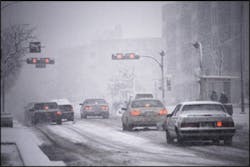
A version of this popular children's game plays out every day on city streets. Motorists can go on green lights, must proceed with caution at yellow lights, and stop at red lights. Unfortunately this is not always the case. In 2007, an estimated 900 people were killed and approximately 153,000 individuals were injured in crashes involving red light running, reports the Insurance Institute for Highway Safety, a nonprofit organization dedicated to reducing losses from crashes on the nation's highways.
To beef up public safety and put a stop to unsafe driving practices a new game has arisen. This game requires motorists to stop at red lights or risk being photographed and ticketed for their violations. It's a practice some say stops violators in their tracks and saves lives, but one that others fear violates privacy and sets the stage to further erode the public's Constitutional rights.
The backlash has photo-enforced communities taking a second look at their systems, and has others backing off on plans to install them. Even some police officials have spoken out against photo enforcement.
Maricopa County (Ariz.) Sheriff Joe Arpaio, for one, is not a fan of automated enforcement. Arpaio was one of the first to sign an Arizona Photo Radar Enforcement Ban Initiative that may appear on the state's 2010 ballot. If this initiative passes, it will prohibit issuing citations for violations detected through photo enforcement.
This prospect makes Todd Kandaris, spokesman for CameraFRAUD, an organization founded to lead the fight against automated ticketing, optimistic. "Whenever a photo enforcement system has been voted on by the public, it has lost," he says. "This shows the public does not want these systems and has had them foisted upon them by their local and state governments."
But those living in communities with successful photo enforcement programs, such as Naperville, Ill., beg to differ. They report that once the public fully understands the need, how they work and what they can do, the backlash becomes nonexistent.
"These systems are another tool to help law enforcement efficiently and effectively do things with limited manpower," says Traffic Sgt. Lee Martin with Naperville PD. "If we can use technology to our advantage to help reduce accidents and injuries, we are absolutely going to do that."
Privacy versus public safety
The biggest outcry over photo enforcement lies with whether private corporations should enforce traffic laws. "Outsourcing a law enforcement function creates animosity toward law enforcement," says Kandaris. He maintains automated ticketing puts enforcement in the hands of a company, which is far different than placing responsibility with those who have the mandate and the authority to police. "We believe this breeds a lack of trust among the citizenry toward law enforcement," he says.
Add to this concerns over Big Brother watching and a loss of privacy, and it's easy to see why photo enforcement opposition has grown among residents from Texas to Illinois to Arizona, says Kandaris. He points out these cameras operate 24 hours a day, seven days a week. And while Shoba Vaitheeswaran, media spokeswoman for Redflex Traffic Systems Inc., a provider of photo enforcement systems based in Phoenix points out, violation cameras only trigger when someone runs a red light, Kandaris still believes they violate a citizen's expectation of privacy, especially when data from captured incidents is kept 90 days to 12 months. "We have a right to a reasonable expectation of privacy," he says. "We shouldn't have to put up with being videotaped everywhere we go."
Vaitheeswaran says she's not surprised by this attitude. Though Europeans and Australians have had photo enforcement for some time, Americans' attitudes about their cars and how our country structures its government presents obstacles. "A lot of Americans feel their vehicle is their private space, but it is registered with the government," she says. "There is no expectation of full privacy on public roads, especially if you've violated a traffic law."
She also points out that fears over Big Brother watching are not as widespread as one might think. In May, Public Opinion Strategies surveyed American voters and found that 69 percent of Americans support the use of "red light cameras" at dangerous intersections. However, nearly 47 percent of those surveyed believed that while they supported their use, the majority of other citizens did not. "This is a stunning result. Rarely in public opinion research do you find voter attitudes so at odds with what they believe others think," notes a Public Opinion Strategies press release about the survey.
These survey results highlight that municipalities need to increase their focus on public education and awareness, according to Vaitheeswaran. "This is a tool that frees up officers to perform other mission critical tasks, instead of sitting alongside the road with a radar gun or at an intersection waiting for violators to pass by."
Reaching out
When Naperville city officials voted to add red light cameras, they trained a watchful eye on informing the public. Keeping citizens abreast of the initiative began with a survey where citizens weighed in on their most pressing concerns in the community; with traffic enforcement at intersections ranking very high. As officials moved forward, they continued to gather public input every step of the way. Public outreach included extensive public education programs, media coverage, posts on the city's Twitter and Facebook pages and public information inserts in utility billing statements.
"We just added two more intersections and we've had no resistance from the community," adds Nadja Lalvani, community relations manager for the City of Naperville. "We've done a really aggressive job of educating the public and we haven't experienced the backlash that other communities have."
Redflex encourages all clients to engage in far-reaching public education efforts such as those at Naperville. There can be a backlash, admits Vaitheeswaran, but fears can be lessened when people better understand the program and what it is designed to do. "Public outreach is not only nice to have, it's a necessity for a photo enforcement program," she says. So important, that states like California and Virginia mandate a public outreach program be in place in communities operating photo enforcement systems.
Branding a program also helps build public awareness, adds Vaitheeswaran, who points out that Lafayette, La., calls its photo enforcement programs SafeLight and SafeSpeed, to foster an identity separate from the company itself. The city created its own logos and regularly releases public service announcements. Redflex helps agencies with this process by providing pamphlets, utility bill inserts and other materials to place a logo on and distribute to the public.
The National Campaign to Stop Red Light Running at www.stopred lightrunning.com also offers promotional materials that include posters, bumper stickers and screen savers for agencies to use.
Elements of public outreach
Public outreach represents the first step in helping citizens embrace these systems. Citizens need to know how the technology works, what it's designed to do, and how it will benefit their community. While public safety is the ultimate goal (red light systems have been shown to reduce accidents at intersections by upwards of 50 percent), if citizens don't understand how the system works or thinks its primarily designed to raise money for the government, it will be harder to gain their approval.
In layman's terms, the technology works as follows: The photo enforcement company equips an intersection with one to two cameras. The city sets the red light violation line, which typically runs from curb to curb. The company installs two in-ground sensors to detect vehicle presence and speed. When sensors pinpoint a vehicle traveling over a certain speed (roughly 15 mph), they activate the cameras based on the probability that the vehicle will not have time to stop before the violation line. Once triggered, the system captures four digital stills and 12 seconds of video, bundles the files into a single encrypted package, and securely uploads the information to the company administering the program.
"Our cameras only snap a photograph if the light is red. They lie dormant in the yellow phase," adds Vaitheeswaran, who notes the systems are not connected to traffic lights and the company does not influence yellow light times. "All we need to know is when the light turns red and when it stops turning red," she explains.
Better scrutiny
The public also needs to know the review process for collected data, adds Vaitheeswaran. "People see these cameras and think they just flash and spit out a ticket, but that couldn't be further from the truth," she says. "This is more scrutinized than when a sole officer issues a ticket."
Because violation packages must hold up in court, three separate Redflex violation experts examine each one, she explains. The first screening process looks at whether the license plate is visible and determines whether the package has violation integrity. The second examination considers whether the incident is a violation according to that city's ordinance. The third screening looks up Department of Motor Vehicles records to cross check vehicle make and model. The company flags the package then sends it to the police department for approval, where the approving officer puts his electronic signature on it saying "Yes, this is a violation" or "No, it should be disregarded."
Naperville PD reviews the tickets that come before them very carefully, says Lalvani. "We don't just write a million tickets and try to raise money," she says, noting strict adherence to a review policy has helped calm citizen fears.
Opponents of photo enforcement question whether police review actually occurs. Shawn Dow, chairman of Arizona Citizens Against Photo Radar, asks how short-staffed agencies have the manpower to designate someone to review tickets each day. But as Martin points out, his officers rarely see more than 20 tickets in a single day, so it's not hard to keep up.
Making money
Citizens may have heard that photo enforcement is simply a means to make money, so it's important for agencies to inform them of where the money goes and why this is not the case, adds Vaitheeswaran.
"In many areas, camera programs have not produced large financial windfalls. Many camera programs do not turn profits at all," reports the National Campaign to Stop Red Light Running. Often revenues only cover program costs, while some programs even lose money, according to the organization.
While a portion of the funds goes to Redflex to recoup administrative and maintenance costs, cities should have a plan for where other revenue may go. Redflex urges clients to tackle the revenue issue head-on. Communities can earmark funds for DUI task forces, highway safety improvements and more. This makes the systems more palatable to many individuals who see the revenue put to good use. Texas, for example, used its money to create a state trauma fund. "There are many great things that can be done," Vaitheeswaran says. "Don't sidestep the revenue issue. Be up front and say, 'Yes, it can generate revenue, and here's how that money will be used.' "
She also notes that as people become aware of the systems, the number of violations decrease and so does revenue. It's not something an agency can count on to be a certain amount every year, she says.
But Kandaris is not convinced. He worries with states and local communities facing budget shortfalls, photo enforcement may be viewed as a way to make money in tough economic times. "Then it's like a drug," he says. "The more they get, the more they want it." A community might make $50,000 off two cameras and think if they double the number they'll make twice as much, and that worries him because it becomes less about public safety and more about generating revenue.
But public safety, say proponents of these systems and those with successful photo enforcement programs in place, is the name of the game. After a 30-day warning period starting January 1, the City of Naperville began issuing $100 fines to red light runners caught on camera. Since then they've already noticed a reduction in red light running and crashes at that particular intersection. And that, not revenue, was their primary motivation for installing the cameras, says Lalvani. "If people don't break the law, the city doesn't make any money," she says. "But that doesn't matter to us, because our primary goal is modifying driver behavior. We want the streets of Naperville to be safe."
With the main goal being public safety and not revenue building, it simply doesn't make sense to keep citizens guessing about your intent, Vaitheeswaran says. When public outreach is front of mind in photo enforcement programs, these programs increase their chances of success. And in this game, where motorists learn to stop at red lights, thus saving lives and preventing injuries, everyone emerges a winner.
Ronnie Garrett served as the editorial director of Law Enforcement Technology for 12 years before leaving to start a photography business. Reach her at www.garrettncostudios.com.
Photo enforcement: 10 facts in a flash
• OTHER MEASURES can do the same thing. Putting speed signs signaling motorist speeds or raising yellow light times reduces speeding and red light running, but studies show this affect may not be permanent. Once motorists get used to a longer yellow light, they may run through them. If they see a sign posting their speed day after day, they may stop slowing for it. A singular approach does not work as well as a varied approach that addresses the many reasons for speeding or running red lights, reports Dr. Bryan Porter, a behavioral psychologist and associate professor at Old Dominion University.
• TWENTY-FIVE STATES allow photo enforcement. Wisconsin and Nevada have banned it, and Hawaii eliminated its photo enforcement programs.
• WARNING PERIODS and signs are important educational tools that help inform the public of photo enforcement programs and the dangers of aggressive driving. In California a 30-day warning period is required by law. "Communities should require an advanced warning program and conspicuous signage as part of a broad-based educational campaign — or risk losing in the court of public opinion. And that could mean losing your program," reports Leslie Blakely, executive director of the National Campaign to Stop Red Light Running (NCSRLR).
• SIGNAGE NOTIFYING motorists of enforced areas by the photo enforcement intersection and throughout the community, can produce a halo effect where red light running at all intersections decreases as people modify their driving behavior and become more cautious as they approach intersections.
• THE U.S. DEPARTMENT OF TRANSPORTATION recommends a full engineering study be conducted before adding a photo enforcement program. Red light running is a complex behavior that needs to be addressed through engineering, enforcement and education, reports the NCSRLR.
• A RED LIGHT-RUNNING ticket does not increase motorists' insurance costs. Nor do red light tickets add points to a driver's license; most states do not report these citations to insurance companies.
• IT DOES NOT take weeks to get citations to motorists. Technology and systems exist that mail the citation within days.
• PRIVATE COMPANIES do not receive a kickback for every ticket issued. Private contractors are compensated by a flat fee recommended by the National Committee on Traffic Laws and Ordinances. In every city violations have dropped dramatically, meaning revenue may only increase for a short time after cameras are installed.
• PHOTO ENFORCEMENT for red light running increases officer safety by taking officers out of harm's way. To ticket a red light runner, officers must put their squad car into an intersection and take a chance of getting hit themselves.
• RED LIGHT RUNNERS can still have their day in court. Motorists have three options: To pay the ticket; to contest it and ask for a court hearing' or to contest their case in writing just as they could with any other traffic ticket.